Alliance, Sovereignty, and the Illusion of Permanence: What Australia Must Now Confront
There are moments in public life when the accumulated weight of unanswered questions becomes impossible to defer. I have spent considerable time in the space where health policy, governance, and democratic accountability intersect, and one pattern recurs with enough consistency to warrant naming it:
Brian Walker
There are moments in public life when the accumulated weight of unanswered questions becomes impossible to defer. I have spent considerable time in the space where health policy, governance, and democratic accountability intersect, and one pattern recurs with enough consistency to warrant naming it: the questions that most need to be asked tend to be precisely the ones that institutional momentum, political loyalty, and the management of appearances conspire to keep unasked. The present crisis in the Middle East is such a moment for Australian strategic policy, and the fact that it arrives while most of official Canberra is focused on managing the optics of alignment rather than examining the architecture of commitment makes it more important, not less, to examine that architecture now.
The United States and Israel have conducted major strikes on Iran. Iran’s Supreme Leader has been killed. Iran has retaliated across the Gulf, targeting US bases and regional infrastructure, disrupting aviation hubs, elevating maritime risk through the Strait of Hormuz, and drawing responses from states whose involvement in this conflict was neither sought nor desired. Leadership decapitation has occurred. Open-ended regime change signalling has accompanied the strikes from the first hours. The operation, named by the Pentagon and carried out with the full weight of American air, naval, and intelligence capacity, has demonstrated something beyond its immediate military objectives: that the United States is prepared, under its present political leadership, to conduct high-tempo, escalatory operations in a theatre far from the Indo-Pacific on the basis of justifications that evolved materially between the opening statement and the second day of bombing.
Walker Briefing is a reader-supported publication. To receive new posts and support my work, consider becoming a free or paid subscriber.
Australia is not a belligerent. The Australian Government has stated that it was not warned in advance and did not participate. It has expressed support for the objective of preventing Iran from obtaining a nuclear weapon. These facts deserve acknowledgement as the baseline, because the argument that follows is not about whether Australia behaved wrongly in the immediate hours of the crisis. It is about whether the structural commitments Australia has made, and the rhetorical posture it has adopted as a consequence of those commitments, are adequate for the strategic environment it now inhabits.
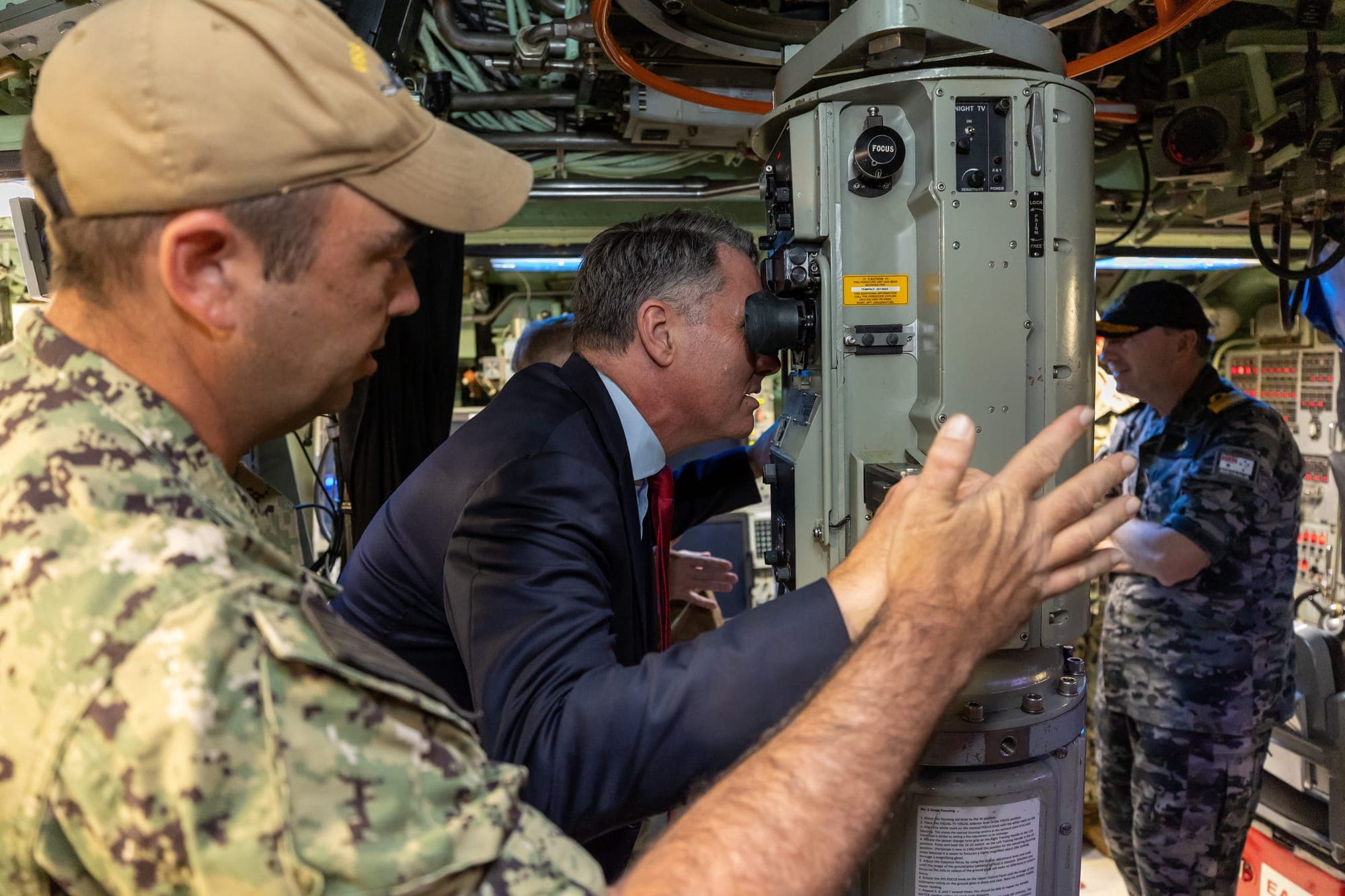
AUKUS has been declared immutable. Financial transfers associated with the agreement are proceeding at approximately one billion dollars per annum. The bipartisan political consensus is that the arrangement is fixed and beyond question. Those three facts, taken together and held against the backdrop of an ally engaged in major combat operations with open-ended strategic objectives in a theatre that competes directly with Indo-Pacific bandwidth, constitute the forcing function for the analysis that follows.
The question is not one of loyalty. Australia’s alliance with the United States has served real interests, produced real capability, and contributed to a regional order that, for all its imperfections, has been more stable than the alternatives available. Nothing in this essay suggests otherwise. The question is architectural: whether the depth and terms of the current commitment are designed for an ally operating at its best, or whether they are robust to the full range of ways in which a great power actually behaves when its own interests are under pressure.
The Sovereignty Question
Sovereignty is a word that Australian political culture uses with less precision than the weight it carries deserves. It appears in debates about foreign investment, in arguments about cultural identity, in discussions of treaty obligations and Indigenous land rights. In each of those contexts it means something slightly different, but the underlying constant is the same: the capacity to make decisions that determine the conditions of your own future, rather than having those conditions determined elsewhere.
In the context of a multi-decade defence integration agreement, sovereignty does not live in the preamble or in the flag ceremony at the signing. It lives in three places, and the condition of sovereignty in each of them is worth examining with some care.
The first is industrial. Australia is committing to a nuclear-powered submarine capability that will, for a considerable portion of its operational life, depend on allied yards, allied supply chains, and allied technical workforces for its maintenance and development. The argument for this arrangement is that it accelerates Australian capability acquisition beyond what domestic industry could produce unaided, and that argument has genuine merit. The question that follows is not whether the arrangement is reasonable in a stable environment, but what happens when that environment is not stable. A nation that cannot sustain, maintain, or reproduce a critical capability without external approval or cooperation has, to that extent, outsourced a component of its operational sovereignty. That observation is not a counsel for autarchy. It is a question about the calibration of dependency: how much of the critical production chain sits under Australian jurisdiction, and at what point does allied industrial capacity become unavailable for Australian operational requirements if that allied capacity is under competing demand.
The second dimension is in decision-making. AUKUS creates deep institutional integration across intelligence, technology, training, and procurement. Integration of that kind does not merely transfer capability. It creates obligations, expectations, and what might be called strategic inertia: the tendency of deeply integrated systems to resist divergence not because divergence is formally prohibited, but because the practical costs of it accumulate so rapidly that divergence becomes effectively impossible without accepting consequences that dwarf the original disagreement. Australia’s history offers instructive cases here. In 2003, the decision to commit forces to Iraq was not imposed by Washington. It was reached in Canberra, by a government that had concluded that the political and diplomatic costs of declining were higher than the strategic costs of participating in an operation whose post-conflict logic had not been publicly examined. The lesson is not that the alliance is coercive. The lesson is that deep integration creates pressures that function like coercion without requiring any explicit demand from the senior partner.
The pattern is not unique to military commitments. In 2015, the decision to lease the Port of Darwin to a Chinese company on a ninety-nine year term was reached without adequate strategic review, and the belated reckoning, arriving years later through pressure from Washington rather than from domestic scrutiny, illustrated the same structural dynamic in economic form: sovereignty questions deferred during the period when they were manageable, then forced onto the table by external events when the costs of addressing them had compounded. The forms differ. The underlying failure is the same: the absence of a standing institutional discipline for examining sovereignty implications before commitments are locked rather than after. The question of whether Australia retains meaningful decision sovereignty within AUKUS has not been publicly answered, because it has not been publicly posed with the seriousness it merits.
The third dimension is fiscal. One billion dollars per annum in transfers to allied submarine industrial bases is not an investment in Australian capability in any direct sense. It is a contribution to the industrial capacity of other sovereign states, on the expectation that this contribution will be repaid through technology transfer, training, and eventually platform delivery. The return on that investment depends on allied political will, allied industrial performance, and allied strategic priorities remaining aligned with Australia’s over the full course of a programme that extends well beyond any current government’s term of office. What enforceable conditions attach to these transfers? What mechanisms exist for Australia to recover value or redirect funds if delivery falls short? What parliamentary oversight exists to audit progress against commitment? These are not minor procedural points. They are the substance of fiscal sovereignty in a commitment of this scale and duration.
Consider the concrete implication: if Australian nuclear-powered submarines are delivered five years behind schedule because allied yards are under competing wartime production demand, Australian deterrence posture in the late 2030s looks materially different from what current planning assumes. That is not a remote contingency. It is a planning scenario that the present crisis has made substantially more plausible, and it deserves to be modelled and disclosed rather than managed through reassurance.
The Costs of Efficiency
There is a governing assumption in contemporary strategic planning that rarely appears in policy documents by name, because it has become so ambient that naming it seems unnecessary. It is the assumption that the optimal system is the one that produces the most output per unit of input: that procurement should be globalised, that capability should be sourced wherever it is most efficiently available, that specialisation and interdependence are evidence of sophisticated coordination rather than structural exposure. This assumption has produced genuine gains in many domains. It has also, when stress arrives, produced failures that were entirely predictable and that were, in fact, predicted by those whose warnings were systematically discounted as inefficient.
The response to COVID supply chain fractures offered the starkest recent illustration. Economies that had optimised away domestic production of particular goods, on the entirely rational grounds that others could produce them more cheaply and that stockpiling was wasteful, found themselves without recourse when supply chains severed and the logic of comparative advantage stopped functioning. The analogy with defence procurement is illustrative rather than exact: the scale, the stakes, and the timelines differ significantly, and no serious person advocates the wholesale domestic manufacture of every component of a modern submarine. But the underlying exposure logic is comparable. Systems designed for a stable, predictable environment carry hidden costs that only become visible when the environment is neither. Those costs are not inefficiency in the ordinary sense. They are a form of strategic debt, accumulated gradually and silently during the periods when the system appears to be functioning well, and called in suddenly during the periods when it is not. A useful operational measure: the United States drew down its Tomahawk stockpiles significantly during operations in the Middle East over the past decade, at rates that created measurable pressure on production schedules and availability for other theatres. Munitions are not submarines, but the competition for allied industrial output between simultaneous theatres is the same structural problem at different scales.
Australia’s approach to AUKUS reflects a version of this logic. The decision to rely substantially on allied yards for nuclear-powered submarine construction and maintenance is not irrational. Given the state of Australia’s domestic industrial base, it may well be the only path to meaningful capability within any politically realistic timeframe. But the efficiency of that path in normal conditions is not the relevant measure of its prudence. The relevant measure is what it produces under conditions of allied distraction, allied industrial stress, or allied strategic reorientation. And those are not remote contingencies. They are operating conditions that great powers enter regularly, without prior arrangement, and the present situation has demonstrated as much with uncomfortable clarity.
The United States is not a malicious actor. It is a large, powerful state with domestic political pressures, global commitments, and a strategic calculus that does not place Australian requirements at its centre. The historical record shows that the United States has sustained simultaneous multi-theatre commitments before, and that it has done so with considerable operational competence. It also shows that sustaining those commitments has always carried fiscal and political costs that eventually compress something: production timelines, training schedules, diplomatic bandwidth, or the sustained attention of senior leadership to long-horizon partnership arrangements. When yards are producing munitions for an active Middle East campaign, when senior naval leadership is managing force protection for bases under missile attack in the Gulf, the bandwidth available for AUKUS technology transfer negotiations, for joint training exercises in the Indo-Pacific, and for the careful coordination of submarine industrial timelines is not what it is in peacetime. This is not a criticism of Washington. It is a description of how large states function under pressure, and it argues for building Australian strategic design around that reality rather than around an idealised version of alliance reliability that the historical record does not consistently sustain.
Resilience, in this context, means something specific. It does not mean autarchy, or the rejection of all external dependency, or the construction of a sovereign submarine capability from scratch without allied assistance. What it means is that critical capability chains carry sufficient domestic depth to function, if not autonomously, then at least without complete dependence on a single allied partner’s uninterrupted attention and industrial output. It means that strategic architecture is designed to absorb disruption rather than to assume its absence. And it means that the financial and political capital invested in capability development is matched by the institutional capacity to scrutinise whether that investment is returning what was promised, against timelines that can be enforced rather than merely hoped for.
What a Mature Alliance Requires
There is a version of alliance loyalty that treats candid assessment as betrayal. On this view, a dependable partner endorses the principal ally’s decisions without reservation, and any public expression of independent judgement is read as weakening the relationship at the moment of greatest strain. This version has a long history in Australian political culture, where it has generally been described as reliability and has sometimes produced, in practice, a willingness to commit Australian lives and resources to operations whose strategic logic did not obviously serve Australian interests.
The alternative is not hostility. It is the disposition of a serious partner: one whose value to the alliance derives in part from its capacity to offer a candid view, to identify second-order consequences that the dominant actor may be too invested in its own course to see clearly, and to decline, where necessary, without fracturing the relationship.
If structural resilience demands sober appraisal of dependency, alliance maturity demands sober appraisal of conduct. The cases in which Australian alliance involvement delivered the most enduring strategic benefit are, generally speaking, the cases in which the purpose was clear, the end state was realistic, and the relationship between military action and the political outcome it was meant to produce was coherent. The cases that left lasting damage, to regional reputation, to domestic political trust, and in some instances to the physical and psychological wellbeing of those who served, tend to share a different profile: early public commitment to an allied course before the strategic logic had been examined, combined with increasing difficulty in acknowledging the divergence between the stated purpose and the observed reality as operations extended.
The current situation does not directly require Australian forces. That is not the issue. The issue is the pattern of public alignment that deep integration reinforces, and the degree to which that alignment is understood, by Australia’s regional neighbours and by the Australian public, as automatic rather than considered. When Australia endorses the stated objective of US operations without reserving public comment on the method, the end state, or the humanitarian and legal questions that serious commentators in multiple allied countries are openly raising, it signals a relationship in which the junior partner has ceded independent judgement as the price of platform access. That may not be the intent. But intent and perception are not the same thing, and in diplomacy the perceived signal shapes behaviour.
Australia’s relationships with its immediate region matter in ways that the current public debate about AUKUS has not adequately addressed. The countries of Southeast Asia, whose support or at least acquiescence is essential to any serious conception of Indo-Pacific stability, are not uniformly aligned with the Western framing of the Iran conflict. Several have publicly called for restraint and de-escalation in terms that reflect genuine discomfort with the trajectory of events, not merely diplomatic formality. They are watching whether Australia’s AUKUS posture represents a genuine contribution to regional stability or an extension of Western power projection that happens to be geographically proximate. That concern is neither irrational nor uninformed. It deserves to be engaged rather than managed.
A mature alliance does not require Australia to endorse every operational choice made in Washington. It requires something more demanding and more valuable: the capacity to remain a serious partner while maintaining the independent judgement that makes seriousness credible. An ally that reflexively endorses is useful as a voting bloc. An ally that engages critically is useful as a strategic counsel. The United States, for all its present assertiveness, is a sophisticated enough state to understand the difference. The question is whether Australia’s political culture, and the structural pressures created by deep military integration, retain enough flexibility to operate in that second mode when the circumstances require it.
The present circumstances require it.
What Stewardship Requires
Reform proposals that emerge from fear are different, in both character and durability, from reform proposals that emerge from a considered account of what a country is actually for. The case for rebalancing Australia’s strategic posture is not primarily a reaction to the present crisis in the Middle East, and presenting it as such would be a mistake. Crises produce urgency, and urgency produces the kind of policy thinking that addresses the presenting symptom while leaving the underlying condition intact. What is needed instead is the kind of thinking that uses the present moment as a prompt for examining assumptions that were questionable before the crisis and that the crisis has simply made more visible.
The case for genuine strategic sovereignty rests on a prior question: what is Australian foreign and defence policy ultimately in service of? The answer that has governed practice for most of the post-war period is, broadly, alliance management. The alliance has been the organising principle, and Australian sovereign interests have been understood largely in terms of maintaining the alliance’s health and demonstrating reliable partnership. That framing has not been without its returns. Access to intelligence, to technology, to operational experience, and to the deterrent weight of great power association has been real and consequential. The question is not whether those returns have existed. The question is whether the framing that produced them is adequate for the strategic environment Australia now inhabits and the one it is entering.
The Indo-Pacific of the coming decades will not be managed by a single dominant power. It will be shaped by the interaction of multiple states with overlapping and sometimes competing interests, and the countries of Southeast Asia, who have spent several centuries developing sophisticated instincts for surviving in exactly that kind of environment, understand this rather better than the strategic cultures of Washington or Canberra tend to assume. What those countries respect is not the appearance of alignment with powerful patrons. What they respect is the demonstrated capacity for independent judgement and the consistent pursuit of interests that can be articulated clearly and that do not shift entirely with the prevailing alliance wind. Australia’s capacity to play a constructive role in the region it actually inhabits depends, over time, on being seen as something other than a reliable extension of external strategic priorities.
None of this requires the abandonment of the US alliance. It requires what might most accurately be called a formal rearticulation of terms: a deliberate, sustained effort to specify what Australia needs from the relationship and what it is and is not prepared to commit to in return, conducted not in the language of gratitude and dependency but in the language of mutual interest between sovereign states. That conversation is overdue. AUKUS has, paradoxically, made it both more urgent and more difficult. More urgent because the depth of the commitment raises the stakes of any misalignment between the parties’ actual interests. More difficult because the political and institutional momentum of a signed and funded agreement creates powerful incentives to avoid the kind of critical examination that might complicate the relationship.
If sovereignty is to mean anything operationally, it must have institutional expression. The oversight mechanisms that would give Australian sovereignty concrete form within AUKUS are not technically complex. What is required is a Parliamentary committee with real power to access classified programme detail and to report publicly on milestones, delays, and cost variances: not a briefing forum, but an accountability mechanism with defined authority to recommend suspension of transfers where agreed conditions have been materially breached and where that breach has not been remedied within a specified period. That is not a radical proposal. It is the application of ordinary fiscal governance to an extraordinary commitment, and it is worth noting that no equivalent mechanism currently exists with sufficient independence, transparency, or remedial authority to constitute genuine public accountability. What is also required is a domestic industrial capability index, updated annually and tabled in Parliament, that tracks the proportion of critical submarine maintenance and production work performed under Australian jurisdiction, so that the trajectory of dependency or diversification is visible in a form that cannot be obscured by ministerial reassurance. And what is required is a regular, published assessment of how AUKUS interacts with Australia’s relationships in Southeast Asia and the Pacific: not a diplomatic exercise in reassurance, but a genuine strategic audit of whether the programme is enhancing or complicating the regional relationships on which any serious conception of Indo-Pacific stability ultimately depends.
These mechanisms matter because their absence from the current architecture is itself a signal. Commitments that cannot survive scrutiny tend to resist it. Commitments that are genuinely in the national interest tend to benefit from it. The reluctance to build rigorous oversight into AUKUS from the outset has created a political culture in which questioning the arrangement is treated as a form of disloyalty, which is precisely the condition that produces the worst long-term outcomes in strategic policy: the gradual accumulation of unexamined assumptions until a crisis forces a reckoning that adequate scrutiny would have anticipated and forestalled.
The broader rebalancing that Australia needs, and that AUKUS in its current form works against unless deliberately reoriented, is a posture that places the Indo-Pacific at the centre of Australian strategic effort not because Washington has defined it as a priority, but because it is where Australia lives. That distinction is more than semantic. When the Indo-Pacific is framed as a US strategic interest that Australia supports, the architecture of Australian defence policy becomes responsive to the rhythm of US attention. When the Indo-Pacific is framed as Australia’s home region, the architecture of policy becomes responsive to Australia’s own assessment of its long-term interests, with alliance relationships as instruments in service of that assessment rather than as ends in themselves.
The practical content of an Indo-Pacific-centred posture is not mysterious. It involves sustained diplomatic investment in ASEAN relationships, including the kind of honest engagement on security questions that does not require ASEAN partners to endorse positions they find politically difficult. It involves domestic naval and maritime capability development that emphasises Australia’s capacity to operate in its own region without requiring constant allied support, as a complement to, not a substitute for, the deeper capability that AUKUS is intended to deliver. It involves an explicit doctrine of strategic autonomy: not independence from alliances, but the demonstrated capacity to form independent judgements about when and how alliance obligations apply, communicated clearly to partners so that there are no surprises when Australian interests diverge from allied preferences.
And it involves, perhaps most fundamentally, a different relationship between the Australian government and the Australian public on questions of strategic purpose. The bipartisan treatment of AUKUS as beyond scrutiny, the management of public concern through reassurance rather than engagement, the refusal to name the trade-offs inherent in any major strategic commitment, these are not the practices of a government confident in its case. They are the practices of a political culture that has decided complexity is too difficult to share. That decision carries costs that compound over time, visible already in rising public unease about annual funding commitments and in the absence of any serious national conversation about what Australia is ultimately trying to achieve in its region and in the world.
Democracies that do not trust their citizens with hard questions tend, over time, to produce citizens who do not trust their governments with hard decisions. The path out of that cycle is not better messaging. It is better reasoning, conducted in public, by leaders willing to hold the genuine difficulty of Australia’s strategic position without resolving it prematurely into slogans or into the false comfort of commitments described as permanent.
The Middle East will not determine Australia’s future. The Indo-Pacific will. The alliances we maintain, the capabilities we build, the relationships we cultivate, and the judgements we are prepared to make independently will either equip Australia to act as a genuine sovereign power in that environment or will leave it dependent, in ways that become increasingly costly to disentangle, on the strategic rhythms of states whose interests overlap with but are not identical to our own. That choice remains available to us. It does not require rupture, it does not require the abandonment of serious security commitments, and it does not require the pretence that the world is simpler than it is. It requires only the political will to govern as though the future matters, and the recognition that sovereignty is not a destination arrived at once and then secured. It is a practice, sustained or surrendered in the choices made during exactly the kind of moment Australia is living through now.
Walker Briefing is a reader-supported publication. To receive new posts and support my work, consider becoming a free or paid subscriber.

Written by
Hon Dr Brian Walker MLC
MB ChB · MRCGP · FRACGP · 45+ years as a GP
Brian Walker is a General Practitioner and Member for Western Australia in the WA Legislative Council. He is the Leader of the Legalise Cannabis Party WA and an advocate for evidence-based cannabis reform, healthcare improvement, and progressive policy in WA.
Share this article
Stay Updated
Get the latest news and parliamentary updates delivered to your inbox