How a Doctor Learns to See
I remember the day she came to the ward with abdominal pain and clearly some sort of intra-abdominal issue. I palpated the abdomen but could not locate an area of concern. She was treated with antibiotics but did not improve. So we did what was usually done in those days. We took her to theatre and
Brian Walker
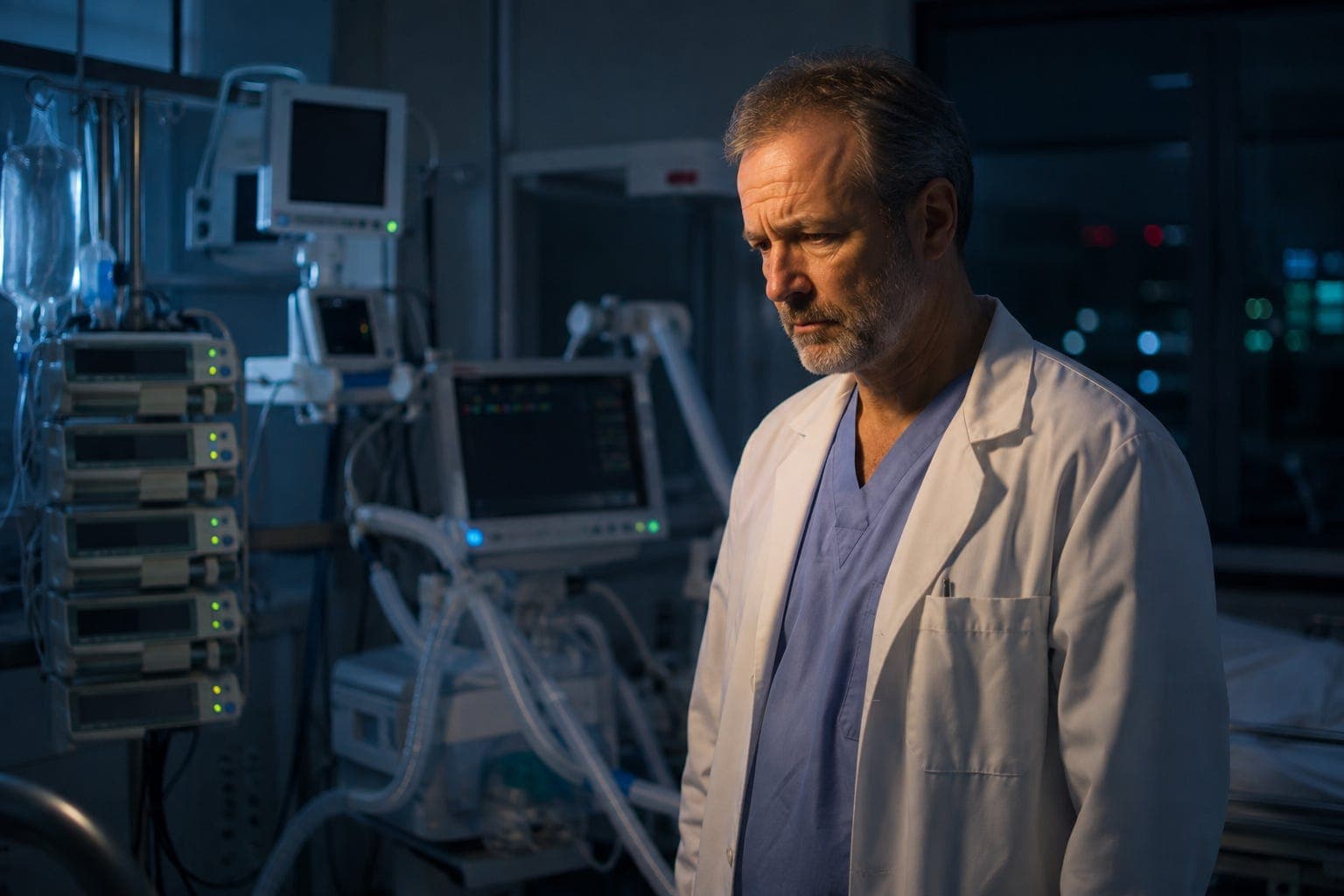
I remember the day she came to the ward with abdominal pain and clearly some sort of intra-abdominal issue. I palpated the abdomen but could not locate an area of concern. She was treated with antibiotics but did not improve. So we did what was usually done in those days. We took her to theatre and opened her up for a look. Laparotomy. She was a young woman with a loving husband and two small children aged two and four. This may have been my first year out of medical school, but clinically I had been an apprentice on the wards for three years, and was a competent clinician as a result. The ultrasound we had in those days was a poor thing by today’s standards, looking at shadows and clouds. It told us nothing much. An X-ray told us nothing. Her bloods said there was an issue, probably an infection somewhere.
Walker Briefing is a reader-supported publication. To receive new posts and support my work, consider becoming a free or paid subscriber.
I assisted at the laparotomy, watching my surgeon and a gynaecologist. I held tools, and they looked, and looked. From liver, stomach, spleen all was in order. Her intestines were laid out and inspected, the pelvic organs searched by hand and eye. Nothing. So the organs were replaced, and she was stitched back together again, still ill, but now recovering from major surgery and needing every bit of strength to recover.
Nothing was found, so we had a mystery. But something was wrong, and while the consultant and registrar debated on the ward rounds, she just deteriorated further. I can still see the husband’s worried face as he came to visit from work before hurrying back to look after his children. I was worried too, but we would find a solution, I was sure.
Nothing found. Not nothing there.
The word came to me on one ward round. She was now seriously ill, and was to be transferred to the intensive care unit as a medical patient, and I was the treating doctor. There was nothing surgical to be found, so call in the medics. That is how it felt to me, standing there, and I have thought about that feeling for a very long time since. I transferred her, and called the medics. Who said she was surgical, but sure, they would advise.
She did not improve. Day by day she worsened. Day by day I searched for information, test after test. The general medical registrar listened sympathetically, and gave me sound advice. On their rounds in ICU they listened to my report, gave advice and moved on. She was, after all, a surgical patient and I was the surgical house officer. The ICU had everything in it. What it did not have was anybody experienced whose patient she was, so it was up to me. If you have seen the film “Zulu” you may recall the frightened soldier asking the company sergeant major the plaintive question “Why us, sarge?” To which the CSM beautifully replied “Because we’re ‘ere, lad. Because we’re ‘ere.” That was me in that firing line because I was there. She was the first time I ever put in a central line. She was the first person for whom I had to consider peritoneal dialysis beyond the textbooks, though it never came to that. Registrars were at the end of a telephone, we discussed on multiple daily ward rounds, I ate my lunch absorbing advice and instructions from the medical registrar, and still absolutely nothing worked. It was terrifying and it was eventually futile.
I knew, every day I knew, that there was something still in there. And so she died. Decades later I still remember every detail of that time. You might call it PTSD, I might agree, but at least the nightmares have ceased. The imagined mewling cries of children seeking their mother, the anguished face of the father as I broke the news to him, the feeling of utter helplessness and being completely alone even surrounded by colleagues and all the apparatus of a fully equipped hospital.
It was not that nobody was listening, they were. The surgical team had handed the issue over as no longer their business, and sage advice was given as theoretical and remote from the patient lying unconscious. I was by her side. The medical team was supportive to a colleague, but this was not their patient. She was mine. When she died, it felt like a part of me died too. But I still needed to know, and so it was only natural that I attend the postmortem examination. That is the time when doctors can learn from their patients, and learn from their mistakes. The team was there, including the surgeon and gynaecologist, and I was watching when the pathologist detected the small collection of pus in the Pouch of Douglas, the source of the infection deep behind the womb, the source of her illness which had been missed by the experts. And missed by me.
That is when my bad dreams became nightmares. For six months I could not sleep, all the while working a job which involved working every second week for 120 hours with four hours of broken sleep if at all. But all I saw at night was the bereaved family and my own failure to save a life as the roundabout nightmare went on and on.
My lesson was learned in an unforgettable way. Experts can get it wrong. Always look for the real cause, the cause that others may overlook or downplay. Never give up, and keep an open mind. In this case it was actually simple. There was an infection in the pouch of Douglas, a small space that sits behind the womb. That space is the lowest point in the female abdomen. Sitting or standing, whatever fluid is in the abdomen can run downhill and gather there. Blood gathers there. Pus gathers there. There is a procedure that exists purely to drain that one spot, because that is where things end up. It was missed. There are so many areas in medicine where something can be missed. Just recently I dealt with a patient whose polypharmacy has been tolerated by a series of colleagues, all of whom prescribed in good faith medication they felt helpful. When I looked at the totality and calculated the risk, there was a high chance of a number of serious adverse reactions, including death.
In that early case, standing there in shock at the pathologist’s discovery, I saw the consultants’ faces. They took note of the cause, realised the failure, and chalked it up to experience. The next time they would not make that same mistake again. Then nothing happened. There was no meeting. I do not mean that a meeting was refused, or that somebody weighed it up and decided her case was not worth an hour. There was no such meeting to hold. The hospital had no machinery for sitting down after a death of that kind and asking how it had come to go that way. It did not exist. The surgeon wrote a cause of death and went on to his list. He never spoke of her to me again, not once, and I have never thought that was coldness. He had done what the system asked of him.
That has changed in the medical world now. Medicine went away and built the thing it did not have. Mortality meetings, critical event review, a room where a death is taken apart in front of the people who were standing there when it happened. None of that arrived by itself. It exists because enough doctors stood where I stood and could not put it down.
Some years later there was a woman with a shadow at the top of her right lung. On the film it looked like tuberculosis. It looked so exactly like tuberculosis that the machinery had already started moving. She was going into a sanatorium, under compulsion, for six months compulsory treatment. Her infant son was just three months old and for the time she was being treated in our hospital she was banned from contact to prevent cross infection. She would next be able to hold her baby when he was nine months old.
I was the treating doctor, still subordinate to a consultant and registrar, both of whom were convinced on the basis of the chest X-ray that she clearly had active tuberculosis. My task was to find the acid fast bacilli, the tuberculosis bacteria that are a major part of the illness. Every test that could have confirmed it came back negative. The laboratory tests showed the presence of an infective process and nothing else. The skin test was negative, and repeatedly stayed negative. Sputum samples showed no acid fast bacilli of tuberculosis. I washed out her stomach and sent the contents for AFB to pathology. Nothing, so repeated and still nothing. In all we repeated the tests three times for all and never once was there any proof of tuberculosis apart from a highly suggestive chest X-ray.
I told the consultant we had no proof apart from the X-ray. He dismissed my concerns. Something, somewhere, just did not fit and speaking up made the experts angry with me. This time I did not let go. I was not prepared to separate an infant from his mother. Something was not right and I needed to find the answer. After some research I came back with five differential diagnoses. Coccidioidomycosis was on that list as was Histiocytosis X, and even if I thought this was over the top, nevertheless the list was going to be presented and discussed. It was not about being correct. It was about refusing the obvious and looking for evidence. Yes, I was challenging authority, and authority was wrong. The question was about what had not yet been excluded.
The list was presented, further tests were organised and she was discharged home with the treated diagnosis of atypical pneumonia.
What changed between those two women was not that I had got better at looking. I was looking just as hard the first time, and for longer. What changed is that I stopped bringing people my worry and started bringing them a list. A worry is an easy thing to put down. A list has to be gone through.
My own father died at fifty. I was young, and it took the ground out from under me in a way I could not have put into words then. What I remember of the weeks afterwards is the talking. People were kind. Nearly all of them said something and nearly all of it was the same something, and not one word of it reached me. I was angry with nowhere to put it, because you cannot be angry at people for being kind to you badly. Platitudes were flung at me about being the “man of the house now” and these came from people who had lost friends and family in war, who had faced their own deaths in the skies over Berlin, and survived. They knew what they were talking about but none of that reached me. It was when I rang a schoolfriend whose father had also died young, and I told him my news. There was a long pause on the line. And then he said, Brian, I know exactly how you feel. That was all of it. He was the only person in my life who said that sentence to me truthfully, and it is a lesson I have used so often since when dealing with loss and grief. It is why I can sit with people now without needing another word. It is something won hard, not trained, but learned when we listen to the lessons we face.
These lessons have coloured my clinical profession and also how I feel to my core as a politician. They are the reason I react in my own way responding to issues I see that affect the people of our nation. These lessons demand of me that I remain a healer, a compassionate man whose passion is for total wellness, always accepting it is our fate to die but also our duty to live the best life we can. It is also the reason I rail at a political life that treats truth, science and humanity as playthings, useful only so far as they help somebody hold on to power.
Medicine looked at its own dead and built something. Government has been going the other way, and I can show you where.
There used to be a document that arrived every year in this state. It is called Your safety in our hands in hospital and it set out what had gone wrong inside our hospitals. How many clinical incidents. How many of the worst kind, the ones where a patient was seriously harmed or died. It came out year after year for more than a decade. The last one is the 2023 edition. There is no 2024 and there is no 2025. The page it sits on does not tell you the series has stopped.
Somebody put the direct question in Parliament: why has nothing been published since 2023, and when are the two missing reports coming. Neither half was answered but what did come back was that the figures are already public, in the annual reports of the health services, and that new webpages were being finalised and would be published in the middle of this year. It is now the middle of August and I have gone looking for those pages and I cannot find them. I have gone looking in the annual reports and I cannot find the numbers there either, and nothing in the department’s own rules obliges anybody to put them there. Somebody is counting, that much I know. The counting travels up the line to a unit inside the department, on a schedule, in confidence, and there it stops and vanishes.
What I want is smaller than a new report and much harder to refuse. It is seeking answers to those similar questions for which I suffered so much early in my career. For truth, for science, for answers that might give closure to those who grieve. They say the numbers are already published. Then there should be no problem in saying where those numbers are, for which service, and which report, and which page, for the two years that are missing. I am putting that in writing this week, as a question on notice, and in those words. I have learned what happens when there is no answer for the person who walks in with a worry.
Long ago we looked everywhere in that woman and found nothing, and we concluded there was nothing. It was at the bottom the whole time, in the place where things collect. There is always a lowest point, and it is always the last place anybody looks, because it is the place nobody wants to. Nobody made me go into that postmortem room at the end. I went because it was the only place left where the truth was.
Walker Briefing is a reader-supported publication. To receive new posts and support my work, consider becoming a free or paid subscriber.
Written by
Hon Dr Brian Walker MLC
MB ChB · MRCGP · FRACGP · 45+ years as a GP
Brian Walker is a General Practitioner and Member for Western Australia in the WA Legislative Council. He is the Leader of the Legalise Cannabis Party WA and an advocate for evidence-based cannabis reform, healthcare improvement, and progressive policy in WA.
Share this article
Stay Updated
Get the latest news and parliamentary updates delivered to your inbox