Informed Consent
What turns a doctor into a criminal? Lack of informed consent. Patients have every right to expect that what a doctor does is for their benefit, and when there is real risk of anything going wrong, especially then, I sit down with them and go through a form. There are four parts to consider, none of
Brian Walker
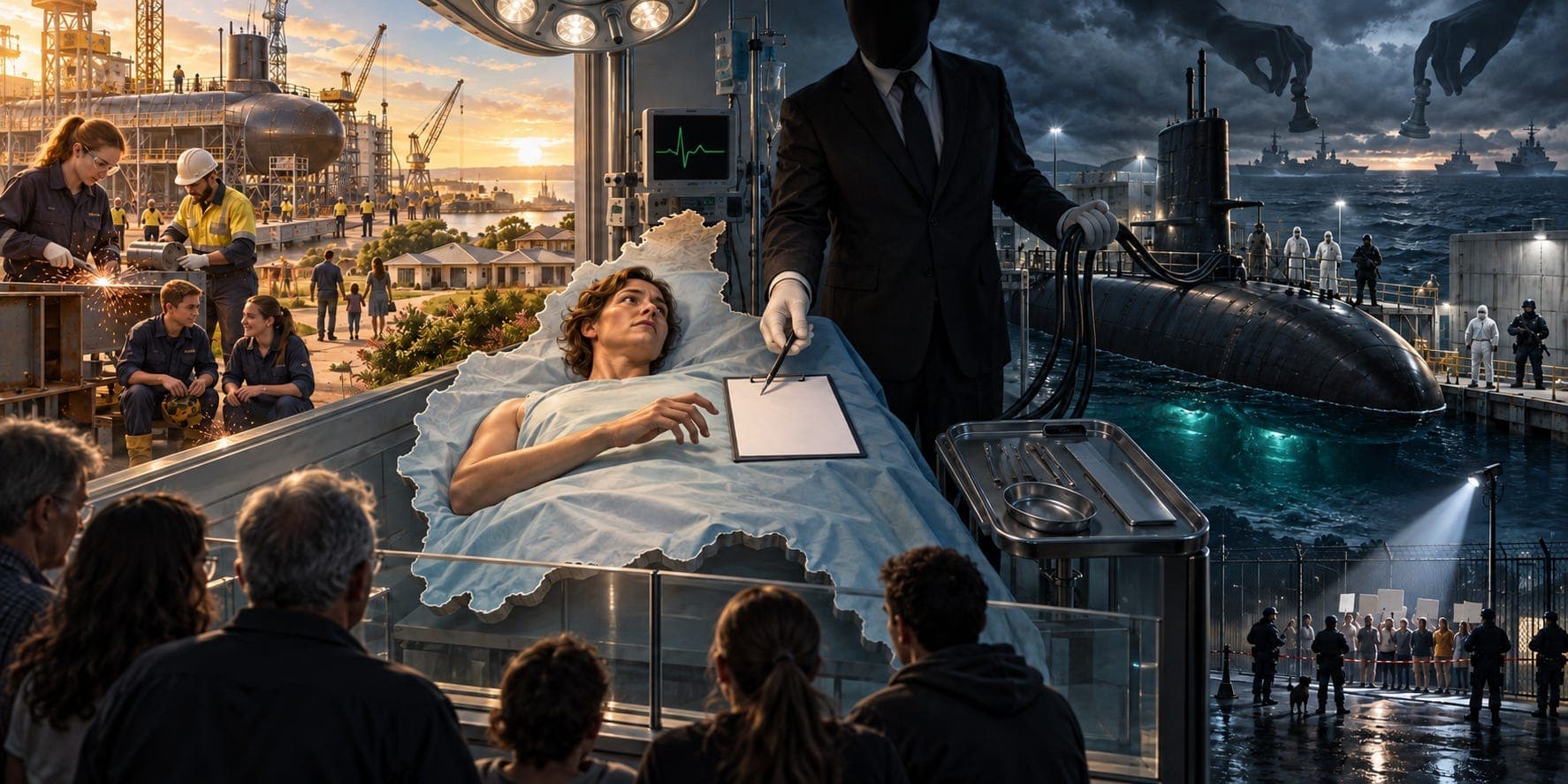
What turns a doctor into a criminal? Lack of informed consent. Patients have every right to expect that what a doctor does is for their benefit, and when there is real risk of anything going wrong, especially then, I sit down with them and go through a form. There are four parts to consider, none of them optional. This is what I will do for you, this is what could go wrong, including the things that are unlikely but serious, this is what else could be done instead. And the last part matters most: do you still agree, now that you know what could go wrong? You are free to say no, and if you do not agree, you should. Signing a form that lists the benefits and leaves out the risks is not informed consent at all, and if that occurs and if it is discovered, then doctors land in front of the medical board with not a leg to stand on.
This week the patient is the State of Western Australia.
Walker Briefing is a reader-supported publication. To receive new posts and support my work, consider becoming a free or paid subscriber.
In the middle of this month a senior American congressman came to Australia. For years he was the chairman of his House’s foreign affairs committee, and on this visit he met our Prime Minister and three of our senior Ministers. Asked whether Australia would join the United States in a war with China over Taiwan, he said, as the Sydney Morning Herald reported it, that it was “absolutely critical” that we did. “I don’t think it was even questioned. It’s just obvious.” Back in Washington, he told The Australian that Australia was already a target for America’s enemies.
What was that again? A politician from another country told us we are already a target? Who else has said anything about this yet? Not our Prime Minister. Not our Premier. Not any Minister who has spent the last three years telling us what AUKUS will do for us. A visitor told us the most important thing on the form, and he told it to a newspaper. I have looked for a reply from Canberra and I cannot find one on the record. One former Prime Minister quickly gave a reply, but more of that in a moment.
Remember that consent form, and the punishment for a doctor who has not complied? Let’s go through it, part by part, and see what Western Australia was actually told.
What it will do for you
This part we have heard, over and over. A Minister in the other place told the House on the eighth of this month that AUKUS “may represent one of the biggest economic benefits for Western Australia in many decades”. When the Government brought in the Bill to make Defence West a statutory authority in June, it said it was “positioning Western Australia as the home of Australia’s nuclear-powered submarine capability”. The Commonwealth has committed an initial twelve billion dollars to Henderson, with more than twenty-five billion indicated over the decade, and talks of ten thousand jobs over twenty years. The Government now expects defence to become the second largest industry in this State.
These are real jobs, and plenty of families in Rockingham and Kwinana will be glad of them. At a time of real cost-of-living pressures and lack of affordable housing, there is promised for some a healthy pay packet. But wait a minute. When a member of parliament this month asked the Treasurer whether anyone had modelled what making defence our second industry would cost every other industry, the answer referred to a diversification framework from 2019 and said nothing about whether any modelling had been done. The question was about the modelling, the answer bypassed the question, and we see a long and glossy benefits section of the form without anyone having costed it.
What we asked
Last week I said I would put four questions to the State. You can check if you want, but I found the State had been asked, again and again, on the notice paper of our own Parliament, and I see no real answer for any of them.
Asked what would happen to radioactive waste from an American submarine tender working at HMAS Stirling, the Government replied that “these questions fall under the responsibility of the commonwealth government”. Asked whether the Premier had been briefed on security, on access to Cockburn Sound, on onshore nuclear waste, the answer last year was that, because Canberra had not yet decided the boundary of the defence precinct, “no briefings have occurred on its potential impact”. I asked the Premier last November whether we had any assurance that American ships based here would keep to international law, and whether this State would prosecute if they did not. “Defence, national security and the United States bilateral relationship are the responsibility of the Australian Government.” I asked about the studies into access to Garden Island. “Work has commenced and is ongoing.”
And this month, while the Westport Bill went through the Assembly, a member asked whether the Royal Australian Navy or the United States Navy could lay sonar or anything else inside a port footprint that is meant to last a hundred years without telling the State at all. The Minister’s answer is worth reading slowly. “Defence has extreme powers in all cases.” And: “we cannot bind the Commonwealth.”
That is the State describing its own position. It does not know, it is not told, and it cannot insist.
What could go wrong
Here is the part of the form that would result in punishment for the doctor should it be left out, and it has never been explained to the people it concerns.
Since the twentieth of August this State has had an Interim State Hazard Plan for the release of radioactive material from a nuclear-powered warship. It was put online and reported once in the press. Its review date is listed as “TBC”. According to a question now on the notice paper, one of its own appendices concedes that an accident worse than the one it plans for is “conceivable”. That question, lodged on the eighth of September, asks whether the plan has been checked against the actual submarines coming to Stirling. It has not been answered. In June I asked the Health Minister about stable iodine, the tablets you give people to protect the thyroid after a radiation release. I was told there are “established plans and exercised processes to pre-position and distribute supplies of stable iodine to local hospitals”. Which hospitals, and how much, I was not told.
Let me be fair, because a doctor who frightens a patient to win an argument is a bad doctor. Nuclear-powered submarines have been visiting this State since 1993 without a release. The plan puts catastrophic failure of a reactor at about one in ten million per vessel, per year, and the Minister says no adverse event has ever occurred. I believe her, and I would still want to be told. In 1992 our High Court held that a one-in-fourteen-thousand risk of blindness was one a patient was entitled to hear about, because a reasonable person would want to know. Rare is not the same as immaterial, and a plan on a website is not a conversation in Rockingham. Nobody in this State has been consulted on the question that matters. The Government set up a taskforce, which ran a survey, which drew nearly nine hundred submissions, and housing came out on top. Of course it did. They were asked about the opportunities and challenges of something already decided. Nobody asked them whether the risks were acceptable. Were they even told what the risks were?
The fine print
Every form has a section in small type about who pays and who decides. Here is our fine print section:
Australia has paid two billion American dollars into the United States’ own submarine shipyards, in three instalments, with another billion pledged. That money builds their capacity. Under their law, before a single boat is handed to us, their President must certify to their Congress that the United States can spare it without weakening its own fleet. Their yards are turning out a little over one submarine a year against the more than two they would need to supply us and themselves. A former Prime Minister, in a submission to an inquiry this year, put it bluntly: there is “a very real risk Australia gets no Virginias at all”. We pay in advance, they decide whether we receive. I have a word for a relationship in which the smaller partner pays tribute and the larger decides what it gets in return, and “alliance” is not it.
Then there is the gap in the story. In 2023, asked whether a promise to fight over Taiwan had been given in exchange for the submarines, our Defence Minister said: “The answer to that is of course not. Of course not. And nor was one sought.” Last year, when the Pentagon pressed us to say what we would do in a Taiwan war, the Government’s answer was that such a decision is made “not in advance but by the government of the day”. This month the visitor says our joining is “just obvious”. Both of those accounts cannot be the whole truth. And Western Australia is the place that hosts the difference between them.
The rules on what the submarines carry have moved too. In July our Minister for Defence Industry said that “nuclear weapons will not be based in Australia”, and in the same breath that we “respect the US position that they will neither confirm nor deny” what any individual boat is carrying. Those two sentences sit together only if you never ask a follow-up question. Our visitor was asked it. The US Navy plans to arm some of its Virginia-class submarines with nuclear cruise missiles from 2032, and he was asked whether boats rotating through Stirling could be carrying them. “I think it’s logical to assume that they would be,” he said. “I really have to be careful on that one.” The honest version for Rockingham is this: if one day there is a nuclear weapon tied up at Garden Island, our own Government will not tell you.
What else we could do
A proper consent conversation always includes the alternatives, and this is where our public debate has failed most completely, because it has been offered as a choice between two things only. You are with Washington, or you are with Beijing. That is a wonderful example of how to phrase a false choice and I refuse it as I hope any sensible person would. There are almost always more than two choices for any situation, but “false dichotomies” are a wonderful tool for misdirecting, and dividing to conquer. A member in the other place, speaking on the Westport Bill this month, put the real alternative better than most: “We want to be an ally; we do not want to be a client.” I am for Western Australia and I stand for Australia, and I do not think either is served by making this coast the forward base of somebody else’s war plan.
Look at where we sit. Our nearest neighbours and our biggest customers are to the north. When AUKUS was announced, Indonesia said it was “deeply concerned” about “the continuing arms race and power projection in the region”, and Malaysia’s Prime Minister warned it could set off a nuclear arms race. The Philippines and Singapore were more welcoming, and Indonesia has since thanked Canberra for its transparency. The region’s view was mixed. My complaint is not that the region was hostile. It is that nobody in this country weighed its view in public. Western Australia, the State closest to those neighbours, the State that sells to them, buys from them and lives beside them, was never asked what it thought.
And we already host one of the facilities that makes Australia part of a planned for war. The naval communication station at North West Cape near Exmouth exists to talk to submarines under the sea. Now let’s be clear, it is sensible and proper to look at exigencies and make plans for the unthinkable, the unlikely, the undesirable, and war and threats of war should be planned for. Serious analysts, including some of the alliance’s firmest supporters, have written for years that Pine Gap would be among the first targets in a war between the great powers. One of our most respected strategic thinkers put the logic in a single sentence: the only circumstance in which Australia could credibly find itself under attack from China would be if we joined America in a war with China over Taiwan. Two former Prime Ministers, one from each side of politics, now say that AUKUS has diminished our sovereignty or that it is “effectively being shredded”. The former Prime Minister who answered our visitor this month said that Taiwan “is not an Australian interest, certainly not a vital Australian interest, certainly not one we would go to war over”. Or would we?
The right to say no
The last part of the consent form is the one that makes it a form and not a notice. You may refuse.
Next month the Land Forces weapons exposition comes to the Perth Convention and Exhibition Centre. For it, this Parliament has passed special police powers running for ten days around a three-day event. They allow search without suspicion across a block of the city, the removal of face coverings, and exclusion lists that people are not told they are on. The ban list includes bicycle locks, superglue and glass jars. When the powers were announced in June, the Police Minister said there was “credible intelligence” that protest groups intended to attend, “including anti-war, anti-AUKUS and pro-Palestinian networks”. Asked in our chamber what that intelligence was, the Government said it “will not be disclosed or discussed any further”.
I spoke on that Bill. I accepted, and I still accept, the intent of keeping police officers and the public safe. What I said in the chamber was that special powers are only special as long as they are special, and that the people who clean the city at six in the morning, or serve in its restaurants at eleven at night, will live for ten days inside a legal regime built for somebody else. I will add this now. When a Government names the people who object to a policy as the reason for suspending ordinary rights, it has told you what it thinks of the most significant and last line on the consent form.
Put all of that together and a diagnosis appears, and it is a structural one. Defence belongs to Canberra; that is in the Constitution and I do not dispute it. I am not claiming a legal veto for this State. I am claiming the truth before the decisions still to come, and a voice in them. So Canberra owns the decision. But the submarines, the dockyards, the hazard plan, the housing pressure, the special powers and the target all live here. The State owns the consequences. And every time a Western Australian asks about the consequences, one level of government can point at the other, saying it is Canberra’s responsibility not ours, while Canberra says nothing at all.
I do not think that requires anyone to be a villain. What we are currently seeing is that every party at the table gains from talking about the benefits and none of them gains from talking about the risks. Our State is not a helpless bystander. We have a voice. A cooperation agreement with the Commonwealth was signed in October 2024, and we are building a statutory authority, a port authority and a hospital plan around this project. Our State’s voice has been used to consent. It has been a “yes”. It is a willing partner and an unwilling advocate. That pattern is not a new one. When the Productivity Commission this year floated changes to how the GST is shared, potentially removing billions from Western Australia’s share, there was not one Western Australian at that table either. Can we trust Canberra to look after the West on something as grave as war? On this record? No.
The case for it
The strongest case for AUKUS deserves to be heard at full strength, and it is not a stupid case. As I said a moment ago, it is sensible and proper to plan for the unthinkable, and the unthinkable includes war. Our trade arrives by sea, our old submarines have to be replaced by something, and a submarine powered by a reactor can stay hidden at sea for months and cover distances a conventional boat cannot. China has built the largest navy in the world by number of ships, and built it fast. Submarines that make any attempt at coercion more costly are deterrence, and deterrence is meant to prevent wars rather than start them. Choosing an ally is itself a sovereign decision, and most Australians agree with the choice: in this year’s Lowy Institute poll, seventy-three per cent said the American alliance is important to our security and sixty-eight per cent supported the submarines.
Now stand on the other shore, because a country that wants to avoid a war has to be able to do that. China looks out from its coast and sees American forces in Japan and South Korea, on Guam and at sites in the Philippines, and from next year a rotating American submarine force working from a base in Western Australia. Seen from Beijing, that is encirclement, and a navy built fast is what a country builds when it believes it is being surrounded. China is no innocent in this. The trade punishment it handed Australia in 2020 was real, and so were the live-fire drills its warships ran off our east coast last year. But both sides make the deterrence argument, from opposite shores. Understanding that is not taking China’s side. It is how you avoid a war.
So the question is not whether Australia should be able to defend itself. It should. The question is whether the case for AUKUS rests on our defence at all, or on something else. Take away the argument for the submarine and look at what is left. A deal negotiated in secret and announced as done. A payment schedule where we fund the American shipyards first and their President decides later whether we get a boat. A rotation of American submarines serving American plans from our coast. And a senior American telling us our part in his war is obvious. That is not the case for a submarine. It is the case for a junior partner that says yes and keeps quiet. Beijing claims Taiwan and has never ruled out force to take it. But in my view the push to put Australia into that war is coming from Washington, not from Perth and not from Canberra. It is Americans who plan for that war and call our joining it obvious, and it is Australians who pay for our part in it, even as the same visitor tells us he would like to see us spend more, and a great deal of what we spend goes on American missiles.
And even if you grant the whole case for the capability, consent still does not follow from it. An operation can be the right operation and still require consent, and the surgeon most certain of being right is exactly the one who most needs the form. Look, too, at what the same poll found on the one question that matters most. If China invaded Taiwan, fifty-three per cent of Australians would oppose sending our military personnel to fight. Only forty-four per cent would support it. The visitor calls our joining “obvious”. Most of us already say no. That answer has never been put to us, and it has certainly never been put to the people who live around the Sound.
What consent now requires
The first rotation of American and British submarines is due at Stirling from 2027. That is the clock. After that, every question on this form gets harder to ask and easier to ignore. So here is what informed consent requires now, for the benefit of the people of this State. All we need is for our State government to agree to present us with the consent form.
Take the hazard plan off the website and explain it, in person and in plain language, in Rockingham, in Kwinana and on the Peninsula, and answer the question on the notice paper about whether it has been tested against the boats it is for. Have Canberra state in writing to this State what has and has not been promised to Washington, including what the submarines visiting our coast may carry. Hold a proper inquiry of this Parliament into what AUKUS means for Western Australia: the risks, the costs to other industries, the housing, the rights of people who object. And let no Australian Government commit our sons and daughters, in advance or by silence, to a war over Taiwan that most Australians have already said they do not want.
You are entitled to ask your member, State and federal, the two questions every patient is entitled to ask before they sign. What are the risks? And can we say no? A signature taken without the risks is not consent. It is compliance, and the people of Western Australia have never been asked to sign.
Walker Briefing is a reader-supported publication. To receive new posts and support my work, consider becoming a free or paid subscriber.

Written by
Hon Dr Brian Walker MLC
MB ChB · MRCGP · FRACGP · 45+ years as a GP
Brian Walker is a General Practitioner and Member for Western Australia in the WA Legislative Council. He is the Leader of the Legalise Cannabis Party WA and an advocate for evidence-based cannabis reform, healthcare improvement, and progressive policy in WA.
Share this article
Stay Updated
Get the latest news and parliamentary updates delivered to your inbox