Put the Number Back
When your own numbers have gone the wrong way three years in a row, you want a doctor who looks harder at that line, not one who takes it off the chart. Western Australia has just had the second kind of doctor. That is all I want to say this week, and everything below is the working. Western Austral
Brian Walker
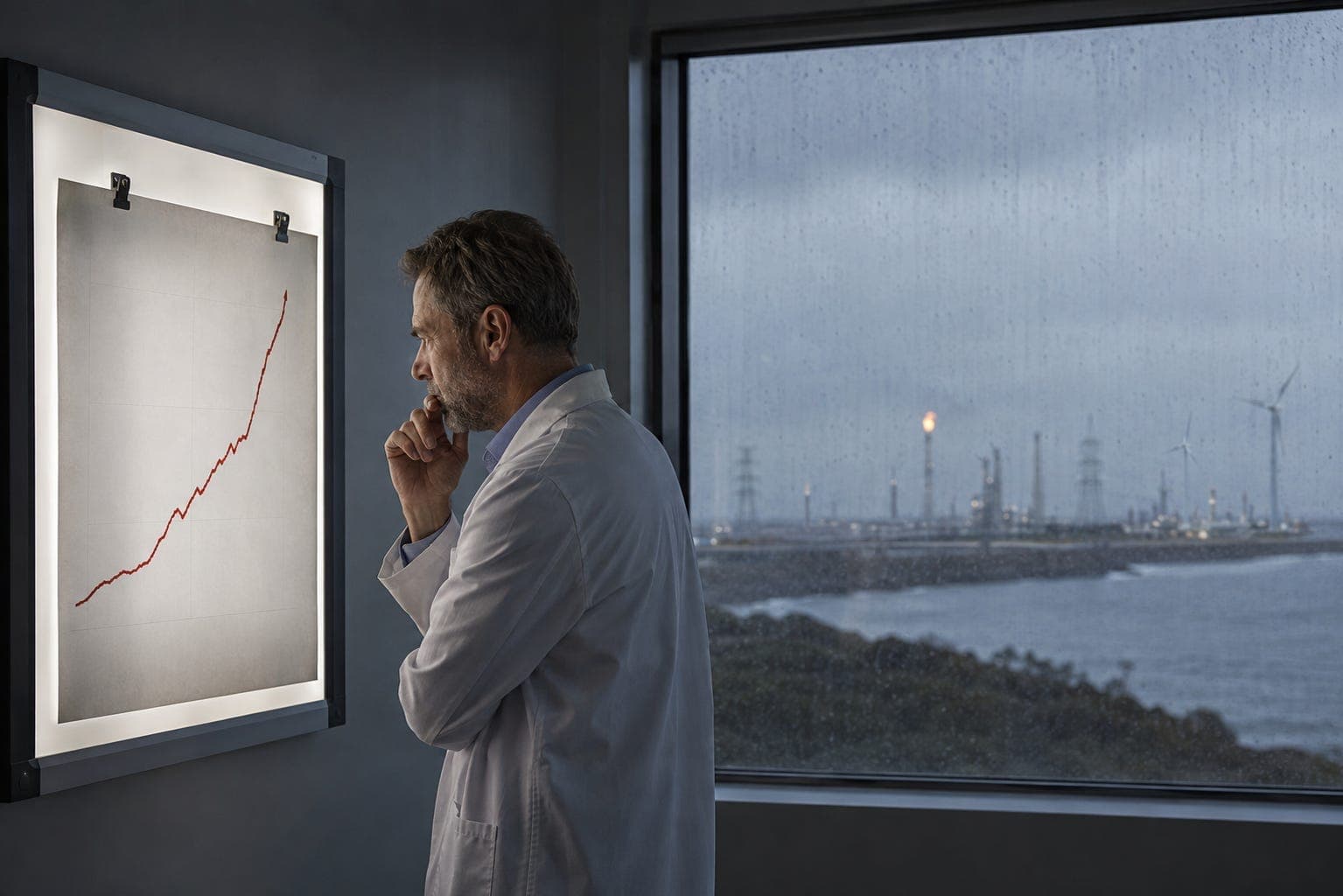
When your own numbers have gone the wrong way three years in a row, you want a doctor who looks harder at that line, not one who takes it off the chart. Western Australia has just had the second kind of doctor. That is all I want to say this week, and everything below is the working.
Western Australia’s emissions have risen three years running. In 2024 they reached just under 91 million tonnes, the highest figure the State has ever recorded, and about a fifth higher than in 2005. Over the same twenty years the country as a whole cut its emissions by roughly a quarter. On the count government itself publishes, we are the only state still going up. Those are the test results. In May this year the Government’s answer to them was to decide not to put an emissions target into law after all. The bill that would have carried one was quietly dropped and its replacement will set targets for renewable generation, for carbon capture, and for something called green exports. The Premier said it himself: the globe’s the winner, but it may mean that Western Australia’s emissions increase.
Walker Briefing is a reader-supported publication. To receive new posts and support my work, consider becoming a free or paid subscriber.
I have read that sentence a good many times now. I think the Premier spoke honestly, which I respect, and I also think it is the sentence of someone who has decided to stop measuring the embarrassing thing. You can do that with a chart. You cannot do that with a patient.
What the chart actually says
Nearly nine tenths of what this State emits comes from energy. The big gas plants on the north-west coast alone account for close to a quarter of the whole State. So we have a split problem. Some of the emitters the State owns: the power stations, the poles and wires, the retailer that sends most of us our bill. The rest it simply licenses, and that part is the bigger part. Keep those two parts in mind, because the Government treats them very differently.
The State half functions well
This is not only about failure. There is good news, and some of the credit is deserved. Nearly half the electricity in the south-west grid in the first three months of this year came from wind and sun. The wholesale price of power, the price the generators get, fell 13 per cent over the past year. The Government has put $1.4 billion into the transmission lines that will carry more of it, and it has set the date 2030 for closing down the coal plants it owns. Independent modelling finds this the cheapest path, and it is the one being taken. Whatever else follows, that stands.
While we are talking about the cheapest forms of low emission energy, nuclear is not it. You may be surprised to hear that nuclear energy is, on the evidence, one of the safest ways of making electricity we have, and that the fear of it is not supported by that evidence. The best independent modelling in this country, however, finds it among the dearest and the slowest firm power we could build. It is also illegal in Australia at present, something we may want to reconsider in the future. For now, though, we already have the cheapest, safest and fastest form of energy production that can actually be built here, so why not just build it out now?
Slow, expensive, and we pay for it
Now the part that made me angry.
The Government gives three reasons for the slow pace of the energy transition. The market operator models a shortfall in supply from 2029 if coal goes and nothing has replaced it. The big new transmission lines are not finished; the northern one should be completed late in 2027, the eastern one at the end of 2029. And thirdly, the battery storage that would let us lean harder on wind and sun is not yet built. All three are true and I accept every one of them.
On two of those three reasons the Government has put its money where the reasons are. The lines are funded and the northern one is being built now. Batteries are going into the grid and into people’s garages with a rebate attached. On the third, the gap between now and the day those lines are finished, it made a different kind of choice. It extended the lease on a private coal mine at Collie to the middle of 2031, and it has paid that mine’s owners, who are receivers, $308 million of public money since 2022 to keep digging uneconomical coal. While the State held its own coal plants to their closing dates, the market operator’s planning assumption for the one private coal station moved from 2027 to 2031. The three reasons were a case for building faster. They were used as a case for paying to wait, and that money should be going into the storage that closes the gap, not into waiting for the lines.
Who pays while we wait? We do, and the bill has been arriving on the same date every year. Power tariffs went up in July last year and again this July. The network charge on our bills went up more than seven per cent, and I know what that charge pays for: it pays for the very lines I want built sooner. My complaint is not that it rose. It is that nothing on the bill shows what it bought. The $400 credit that used to soften the July letter ended a year ago and was not brought back. Meanwhile, how much of the wholesale price reduction, the one that fell 13 per cent, reached you? The part of the bill that rose is the part the State itself collects. The State’s own generator booked a $778 million loss last year, much of it writing down the coal plants it is closing, and had already, by the ABC’s account, asked for close to a billion dollars in support and been told to borrow instead. Nobody, as far as I can find, has yet asked why.
I have said I can hear the economic case for keeping Collie going, and I can still hear it. But a case for going slowly is not a case for paying a failed mine to set the pace.
The half the State licenses, and will not measure
The gas plants are a different matter, and the difference is the one the Premier’s sentence was built on. The State does not own them. Their emissions sit under a Commonwealth scheme the State does not report on. And when the Government says the globe is the winner from our gas, what it is saying is that other big emitters burn less coal because of it, while our own emissions rise as we extract the gas we export. That is the Government’s claim, and it may or may not be the whole truth. It is a claim about tonnes somewhere else, and the Government has never published a single one of them. This week the West Australian reported that Woodside Energy has cut billions from its project pipeline and will abandon all of its Scope 3 targets, the ones about the emissions of the people who burn its gas, having met its own Scope 1 and 2 targets for the emissions it makes itself. I do not blame a company for dropping a promise it could not keep. I do notice that the Government’s argument for dropping its own targets rests on other people’s numbers, and the biggest of those people has just stopped promising to produce any.
And then there is the money, which is where this joins the piece I wrote last week about who pays for Western Australia. The State’s take from oil and gas was $1.3 billion three years ago. This year it expects $365 million, and by 2028 less than $250 million. Most of the gas that leaves this coast pays the State nothing at all, because it comes from Commonwealth waters and pays a Commonwealth profits tax instead. The one exception, the North West Shelf, returns about two thirds of its royalties to us only because Canberra agreed to share them back in the 1980s. Nobody has agreed to share anything since. Our emissions go up, the measurement goes away, and the money goes east.
There is one more thing sitting in plain sight. Since 2012 this State has had a Future Fund, built to take one per cent of the royalties and hold it for the generations who will not see the gas. Our resources generate our wealth, and the State’s own take from that wealth is small and shrinking. We are ten per cent of the country’s vote. On GST we get back a floor of 75 cents in the dollar, and the Productivity Commission has just recommended taking that floor away. The Prime Minister says nothing will change while he is Prime Minister. A promise is not a law, other states are already agitating, and that fight has only just started. Meanwhile one per cent of royalties into a Future Fund is a paltry thing. Norway put its oil money into a fund for its people, and that fund is now very likely at or above three trillion US dollars. I want ours enlarged, protected, and left alone to do the job it was built for, for our children and their children.
What I would do, in order
Five things. I will say one thing first. I told the Council what I think about the science, and some readers will not agree with me. I am not going to spend this piece arguing with them, because nothing below depends on winning that argument. This is about energy, emissions, and what a State does with the numbers it has.
First, get real. Put the numbers back: the floor should be the national 2035 target, 62 to 70 per cent below 2005, with a waypoint in 2030 so nobody can coast. Every year the Government tables the State’s inventory in Parliament, plant by plant for the big emitters. As for the green exports target: either it says how many tonnes it avoids at the other end, or it goes. And I will own something. In 2022 I told the Council that net zero by 2050 was not good enough: “I think 2030 is appropriate, perhaps even 2025 would be ideal because we do not have a day to waste.” I was right about the mechanism, which is that only a near date changes behaviour. I got the year wrong.
Second, govern what you own on the evidence. Hold 2030 for the State’s coal. End the Collie subsidy on 30 June 2029, the year the eastern transmission line comes on, and contract the storage that covers the 2029 gap now, so that when the mine’s money stops the plant is not the only thing standing between us and a shortfall. If the Government cannot contract that storage in time, it should say so in public and argue for the extension on the record, rather than pay the mine in silence. Publish, every year, how the Government is going against its own promise to cut its own operations’ emissions 80 per cent by 2030, a promise with no public scorecard. And examine Synergy’s loss rather than refinance it. Last week I wrote that I was proposing no change to royalties or taxes in that piece. I am proposing one now, and I would rather say so than have someone find it.
Third, argue for the State’s share. Go to Canberra and ask for every tonne of gas processed on this coast to be put on the same footing as the North West Shelf, with the State’s share of the take that the Shelf has returned to us since the 1980s. Most of those projects pay no royalty at all today, only a Commonwealth profits tax, so that is an argument, not a power; the State cannot simply levy it. Then put the proceeds where the 2012 Act already says they belong.
Fourth, plan for what is coming. The market operator already sees a gap in domestic gas supply in 2028, and a gap in electricity from 2029. The sea is taking ground at Lancelin and the fire season in the South West is lengthening, and both need adaptation money, not a media statement. And one small thing I have argued for since 2021: a proper State trial of industrial hemp as a biomass and building crop. The best field trials I can find put its energy yield at about two thirds of maize as gas and two thirds of willow as solid fuel, which is useful, not miraculous, and nobody has yet run the trial here that would tell us what it does in our soil.
Fifth, protect who pays. Publish the wholesale price beside the retail one every July, so that the year the generators get cheaper and your bill gets dearer is visible on one page. Put hardship and disconnection figures out on a fixed date. And say plainly that the end of the electricity credit was a decision, taken by a Government, and not weather.
Two mistakes to avoid
I do not think nuclear power is the answer here. The evidence says it is among the slowest and dearest on offer, and I have said so and will keep saying it unless the evidence demands a rethink.
I will not let green exports stand in for tonnes. Shipping more of something is not the same as emitting less of it. If the Government wants credit for the globe’s emissions it can produce the globe’s numbers.
Back to the chart
A doctor who takes a line off the chart has not treated the patient. He has changed what he can be blamed for. This State governs the grid it owns with real competence, refuses to measure the industry it licenses, and the household sits at the end of both, paying the tariff on the first and carrying the warming from the second.
In the face of a changing climate, a first act of a climate policy for Western Australia is not a solar panel or a speech. It is to put the correct numbers back on the chart, in law, with a date, and then to be held to them. That is what an upstream approach to a downstream problem looks like. Everything else on this page follows from that one honest line, and none of it can be held to account without it.
Walker Briefing is a reader-supported publication. To receive new posts and support my work, consider becoming a free or paid subscriber.

Written by
Hon Dr Brian Walker MLC
MB ChB · MRCGP · FRACGP · 45+ years as a GP
Brian Walker is a General Practitioner and Member for Western Australia in the WA Legislative Council. He is the Leader of the Legalise Cannabis Party WA and an advocate for evidence-based cannabis reform, healthcare improvement, and progressive policy in WA.
Share this article
Stay Updated
Get the latest news and parliamentary updates delivered to your inbox