Read It With Me
Last week I left you with three questions. This week I want to use them, on a real page, together. So get yourself a cup of tea and read it with me. On Wednesday The West Australian ran an opinion piece by the chief executive of ASC, the company that keeps our Collins submarines at sea. ASC is owned
Brian Walker
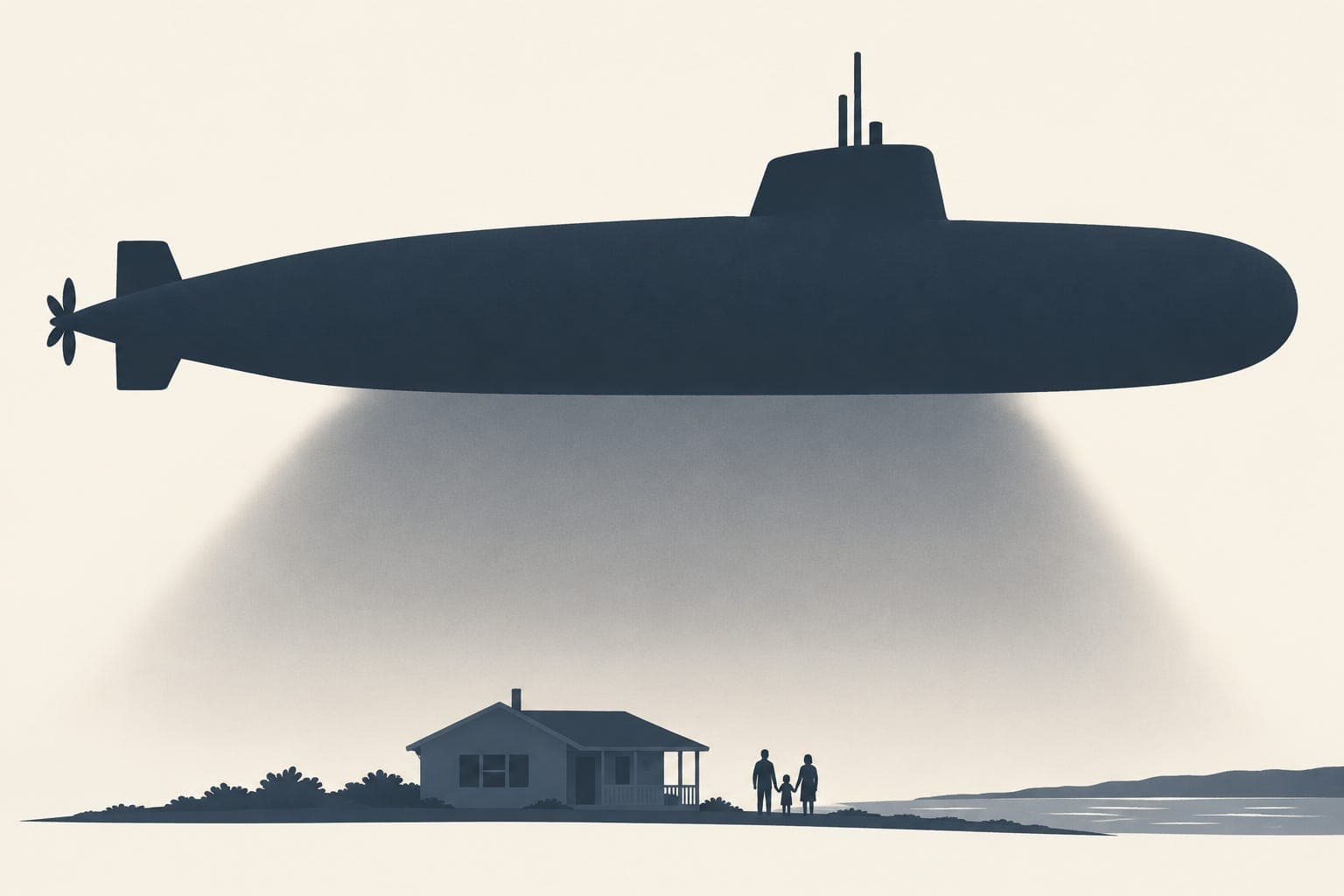
Last week I left you with three questions. This week I want to use them, on a real page, together. So get yourself a cup of tea and read it with me.
On Wednesday The West Australian ran an opinion piece by the chief executive of ASC, the company that keeps our Collins submarines at sea. ASC is owned by the Commonwealth, and it has been chosen to service the nuclear-powered submarines at HMAS Stirling. The headline told you what the piece was for: AUKUS will provide Western Australia with long-term economic sustainment. Across town, at the Perth Convention and Exhibition Centre, the Land Forces weapons exposition was in its second day. And that same morning, at a defence breakfast run by the paper itself under its Leadership Matters banner, the Acting Prime Minister, Richard Marles, told a room of hundreds that Perth is “Australia’s geostrategic ground zero”.
Walker Briefing is a reader-supported publication. To receive new posts and support my work, consider becoming a free or paid subscriber.
Ground zero. He meant the centre of things, the place that matters most. It is worth remembering where the phrase comes from. Words are chosen, and some carry more than the speaker intends.
Before we pick anything apart, a word of fairness, because the author has earned it. Alex Walsh is doing his job, and doing it well. His job is to make the case for his company and the people it employs, and that is what he did. The jobs he describes are real. The skilled men and women at Henderson and Rockingham who have kept our submarines running for thirty years are real, and they deserve our support, more of them, and a future. I mean every word of that, and nothing that follows takes it back.
But a page in a newspaper is a selection, like every page. So let’s ask the questions.
What’s missing?
The piece tells you that “around 70 per cent” of what we spend on a major defence program goes on sustainment, the decades of maintenance, repair and support after the thing is built. It calls this “where much of the long-term value lies”.
Now hold that thought, and remember the consent form from a fortnight ago. A proper consent form has four parts: what it will do for you, what could go wrong, what else could be done, and whether you agree. Walsh has written the first part, beautifully. The other three are not on the page.
There is no cost on it. The submarine program is estimated at between 268 and 368 billion dollars over thirty years, and that top figure includes an allowance for overruns of about half again on top of the central estimate. Ordinary big projects carry a fraction of that. There is nothing on who pays, or where the money goes.
There is nothing on the reactors. Under the treaty, the nuclear fuel arrives in what the agreement calls “complete, welded power units”. Sealed. We cannot open them, and without the written consent of Washington or London we cannot share what is inside them with anyone. When the boats are finished with, the spent fuel and the radioactive waste are ours to manage, store and dispose of. And we have agreed to indemnify the United States and the United Kingdom against any liability, loss or injury arising from the nuclear risks. If something nuclear goes wrong, with few exceptions, the cost is ours. That is in the fine print, and it did not make the page. There is a current example in Scotland. HMS Swiftsure left the Royal Navy in 1992. She is the first British nuclear submarine to be taken fully apart, at Rosyth, and the job will not be finished before the end of this year, more than thirty years after she left service. Britain’s very first, HMS Dreadnought, left service in 1980 and is still waiting at Rosyth. More than twenty retired British nuclear submarines are waiting their turn there and at Devonport. Their reactor vessels are being stored at Capenhurst in Cheshire until Britain has somewhere permanent to bury them, which its own Ministry of Defence says will be some time after 2040. Joy for us in Western Australia at some time in the future then?
There is nothing on whether we get the boats at all. American law says their President must certify to their Congress, before any transfer, that handing a submarine to us will not weaken their own fleet. We have committed three billion US dollars to their shipyards and 4.6 billion of ours to Britain, to expand Rolls-Royce’s reactor works in Derby, and the company says that money will create over a thousand jobs in Derby. Last financial year we spent about two billion dollars more on the program than was budgeted, much of it cash for American and British shipyards. The plan now is for three second-hand American boats, the first in 2032. Nothing in the piece mentions any of this.
And there is nothing on you. On the people of Rockingham and Kwinana, on the family trying to build a house, on whether anybody here was asked.
Here is the odd thing. The counter-evidence was on the same page. Under the essay online, the paper ran a short video. Its caption said the State faces “a major tradie shortage”, with the Henderson project “requiring 10,000 workers and threatening to exhaust Perth’s concrete supply”. I could not find the source for the concrete claim, and the official figure is around ten thousand jobs over twenty years rather than ten thousand workers at once. But the paper’s own video was telling you what its essay left out: that this program competes for the same hands, and the same materials, as everything else we need to build.
What’s been linked that isn’t linked?
Three things are sitting side by side in that piece so that one seems to explain the other.
The first is the money. Seventy per cent sounds like a prize until you turn it round. It is the share of a weapon’s lifetime cost that is spent after it is bought, and it is paid by you, every year, for decades. It is the figure the United States Government’s own auditors use, describing American weapons, and it includes the crew’s wages and the fuel, not just the work done in a shipyard. A thirty-year bill has been dressed as a thirty-year windfall. Can we agree that those are not the same thing?
The second is Collins, and this is the one I want you to look at hardest. Walsh writes that Western Australia has “spent decades building expertise in submarine maintenance”, and that “the Collins Class experience shows what is possible”. He is right. ASC set up at Henderson in 1996 to support Collins, and today a few hundred people work there directly on it. In 2012 an independent review found that Collins availability was by far the worst of seven submarine-operating nations. By 2016 the same reviewer called its performance excellent, at a lower cost per day at sea. The fleet has had its troubles again since. But look at what happened in between. Australians fixed an Australian fleet, in Australia, under Australian management. About ninety per cent of the Collins sustainment budget is spent here.
So the skills he is proud of were built before AUKUS existed, on a conventional submarine that we controlled. Those jobs did not come from AUKUS. They come from Australia choosing to run a submarine fleet and to look after it at home. Put the two side by side and the link falls apart: you do not need AUKUS to keep a welder in work at Henderson. You need a navy that is ours, and the will to maintain it here.
The third link is quieter. The piece says three times that the boats Australia will acquire are “conventionally armed”. That is true of our boats. It is silent on the American and British boats arriving at Stirling next year, which is where the honest question lies. As I wrote a fortnight ago, our Government will neither confirm nor deny what they carry. We have not been told, and we will not be. A senior American congressman, Michael McCaul, told us it was “logical to assume” some of them may one day carry nuclear weapons.
Who says it’s one or the other?
The piece ends by asking you to look at AUKUS through two lenses, a security lens and an economic lens. Both, it says, point the same way. So the only question left is how much we stand to gain.
Who decided there were two lenses? There is a third, and it is the one that matters most to me: the people who live here and carry the consequences. That lens is missing, and not by accident: nobody on that page was paid to hold it up.
That is my job. I am one of thirty-seven members of the Legislative Council, and every one of us was elected to look after the wellbeing of the people of this State. The chief executive of ASC speaks for ASC, as he should. The Commonwealth speaks for the Commonwealth. Who speaks for Rockingham? Not one sentence on that page spoke to its worries. So here is mine.
A base in all but name
In England there are airfields called RAF Lakenheath and RAF Mildenhall. The sign at the gate says Royal Air Force. The aircraft are American, the crews are American, and so are the wings that fly from them. Everyone in Suffolk knows it.
Look at what is happening at Garden Island. In May the United States Navy stood up its own support command there, called Naval Support Activity Stirling. From next year up to four American submarines and one British one will rotate through, with around a thousand American personnel, the Deputy Prime Minister’s own figure, plus civilians, contractors and families. When the Deputy Prime Minister was asked how long those rotations would last, he said it would be “a function of the operational requirements of the US submarines”. Their requirements, not ours. Asked at Wednesday’s breakfast whether we should expect a “battle of Rockingham”, like the wartime brawl between Australian and American servicemen in Brisbane, he said: “I don’t think so. I think the people of Rockingham, the people of Perth, are looking forward to this.” Notice what he did in that second sentence: he answered for the people of Rockingham. Who asked them? Meanwhile the State has put land in Rockingham out to market for housing “with a focus on increasing the supply for Australian and AUKUS Defence personnel”.
The Minister for Defence Industry says, “We don’t have foreign bases in Australia.” In law, he is right. The land stays Australian. But a base is what a place does, not what the sign says, and when another country’s navy runs its own support command on our island, decides how long its boats stay, and plans its operations around them, the name on the gate starts to matter a good deal less. In my view we are watching an Australian base become somebody else’s, step by step, without anybody ever being asked. I will not accept that. I do not think most Western Australians would, if it were put to them plainly.
Australian dollars for Australia’s defence
So where should the money go? My answer is simple, and I think most people would agree with it once it is said out loud. Australian dollars spent on defending Australia should be spent in Australia, on Australian people and Australian services, on a capability we control.
Set the two models side by side. Collins: built here, fixed here, about ninety per cent of its sustainment budget spent here. AUKUS: the first and fastest cheques written to American shipyards and to Derby, the reactors sealed against us, the boats subject to another country’s certification, and nobody in government willing to tell you how much of the 368 billion will be spent on our own shores. I have looked for that and not found it so we possibly have an as yet unpublished figure that is known to somebody, just not us.
And there are other ways to watch our seas. Our own Government is already buying an undersea drone called Ghost Shark, designed and built in Sydney, for 1.7 billion dollars over five years, with dozens in the first batch. To be straight with you, it is built by the Australian arm of an American company, and the Government describes it as working alongside submarines rather than replacing them. Fair enough. But think about the scale. Less than one per cent of even the lowest estimate for the submarines buys a whole fleet of uncrewed vessels, made here. If one is lost, nobody’s son or daughter is lost with it. People who serve and have served in our Defence Force have told me they would far rather see more of that, and I agree with them. That is a defence of Australia, built in Australia, and it keeps people in work.
Then there is everything else we need to build. Western Australia has one major brick maker. Maxi bricks are on allocation and back-order, and the State is putting up to four million dollars into reopening a mothballed kiln, with a payment for restarting it by March next year. We build in double brick here more than anywhere in the country. Into that, add a defence precinct, a port and housing for a foreign navy’s families, all competing for the same tradies and the same materials as the young couple in Baldivis waiting on a slab. I am not saying AUKUS caused the brick shortage. I am saying it is joining the queue, and the queue was already out the door.
The State keeps no tally
You would think, with all of this, that our State Government could tell you what it is spending. In May, at budget estimates, a member asked the then Minister for Defence Industries exactly that: how much does the State spend on AUKUS this year? The answer: “No, I cannot because AUKUS is, firstly, a Commonwealth initiative.” And later, “we do not have some sort of tally of what is allocated to AUKUS.”
He promised to provide a list. The Director General then listed what the State counts as AUKUS-related investment: a hundred million dollars for local high schools, eighteen million for mental health services at Rockingham General Hospital, and five million for industrial upgrades. Read that again. Most of it is schools and mental health care in the south-west corridor. Those are not defence projects. Those are things the people of Rockingham needed anyway, and were already waiting for. If it takes a foreign submarine force to get them, what does that tell you about every suburb that is not hosting one?
So the Commonwealth decides, and says the consequences are the State’s to manage. The State says it is a Commonwealth initiative and keeps no count. Each points at the other, and the person in between is you.
Our neighbours
There is one more cost that never appears on a jobs page. Every dollar and every hour of attention we pour into one relationship is a dollar and an hour not spent on the region we actually live in. When AUKUS was announced, Indonesia said it was “deeply concerned” about “the continuing arms race and power projection in the region”. Those are our nearest neighbours, our customers, the people this State trades with every day.
China is not an innocent party in our region. It punished our farmers and winemakers, and it has pushed smaller countries around in the South China Sea. I have not been afraid to say so. But it looks to me as if this base is being built for somebody else’s plans in our part of the world, and that our role in those plans has been decided somewhere other than here. The same congressman told us last month that our joining a war over Taiwan was “just obvious”. Most Australians, asked by the Lowy Institute in March, said they would oppose sending our personnel to that war. The same poll found that about two in three of us still support the submarines and I can understand why. We are told they keep us safe. That claim has never been tested in front of us. I am asking you to look at what else comes with them, and whether anyone has ever shown you the whole form.
What I will do
A fighting article that ends with a shrug is of no use to anyone. So let me tell you where I stand, and what I intend to do.
AUKUS asks Western Australia to host and service a foreign navy’s forward base, and to pay, much of it offshore and on terms set abroad, for boats we may never receive. The people who carry the consequences have never been shown the full terms, or asked whether they agree. The jobs case does not answer that, because the skills it is proud of were built on a fleet we controlled, and a defence of Australia that is built, spent and controlled here would employ those same people. Western Australians are owed the consent form before anything further is signed in their name. Having read as much of it as I have been allowed to see, my answer is no.
In Parliament, I will move for a select committee of the Legislative Council to inquire into what AUKUS means for Western Australia: the risks, the costs to our other industries, the housing, and the question nobody has asked, which is whether the people here agree. I will press the Government to publish the list it promised at estimates and for a published tally of everything this State spends in AUKUS’s name, because a government that keeps no tally of what it spends cannot tell you what it costs. I will keep asking for a written statement from the Commonwealth to this State setting out what has been promised to Washington, and what the boats tied up at Garden Island may carry. And I will argue, as a plank of everything I put forward from here on, that money spent on defending Australia is spent in Australia, on people and capability we control.
None of that needs you to agree with me today. It needs you to do what you just did: read the page, ask what is missing, ask what has been linked that isn’t linked, and ask who decided there were only two lenses. Walsh wrote his part of the form. The rest of it belongs to you.
Walker Briefing is a reader-supported publication. To receive new posts and support my work, consider becoming a free or paid subscriber.
Written by
Hon Dr Brian Walker MLC
MB ChB · MRCGP · FRACGP · 45+ years as a GP
Brian Walker is a General Practitioner and Member for Western Australia in the WA Legislative Council. He is the Leader of the Legalise Cannabis Party WA and an advocate for evidence-based cannabis reform, healthcare improvement, and progressive policy in WA.
Share this article
Stay Updated
Get the latest news and parliamentary updates delivered to your inbox