The Geometry of the Vote
Electoral Architecture as Structural Variable On 21 March 2026, more South Australians gave their first preference to One Nation than to the Liberal Party in the contest for the House of Assembly. Across the state One Nation drew 256,022 primary votes, or 22.9 per cent, against the Liberals’ 211,55
Brian Walker
Electoral Architecture as Structural Variable
On 21 March 2026, more South Australians gave their first preference to One Nation than to the Liberal Party in the contest for the House of Assembly. Across the state One Nation drew 256,022 primary votes, or 22.9 per cent, against the Liberals’ 211,551, or 18.9 per cent. The margin was 44,471 votes. One Nation won four seats. The Liberals won five, and it is the Liberals, not One Nation, who sit as the Opposition in the parliament that resulted.
Walker Briefing is a reader-supported publication. To receive new posts and support my work, consider becoming a free or paid subscriber.
A result of that shape is not produced by campaigning, or by the quality of the candidates, or by anything that happened in the five weeks before polling day. A party can outpoll another across an entire state and still finish behind it in seats, and end up watching that smaller party take the Opposition benches, for one reason only: the rule used to turn votes into seats produced it. The shape of the parliament was settled by something other than how South Australians voted. That something is the subject of this article.
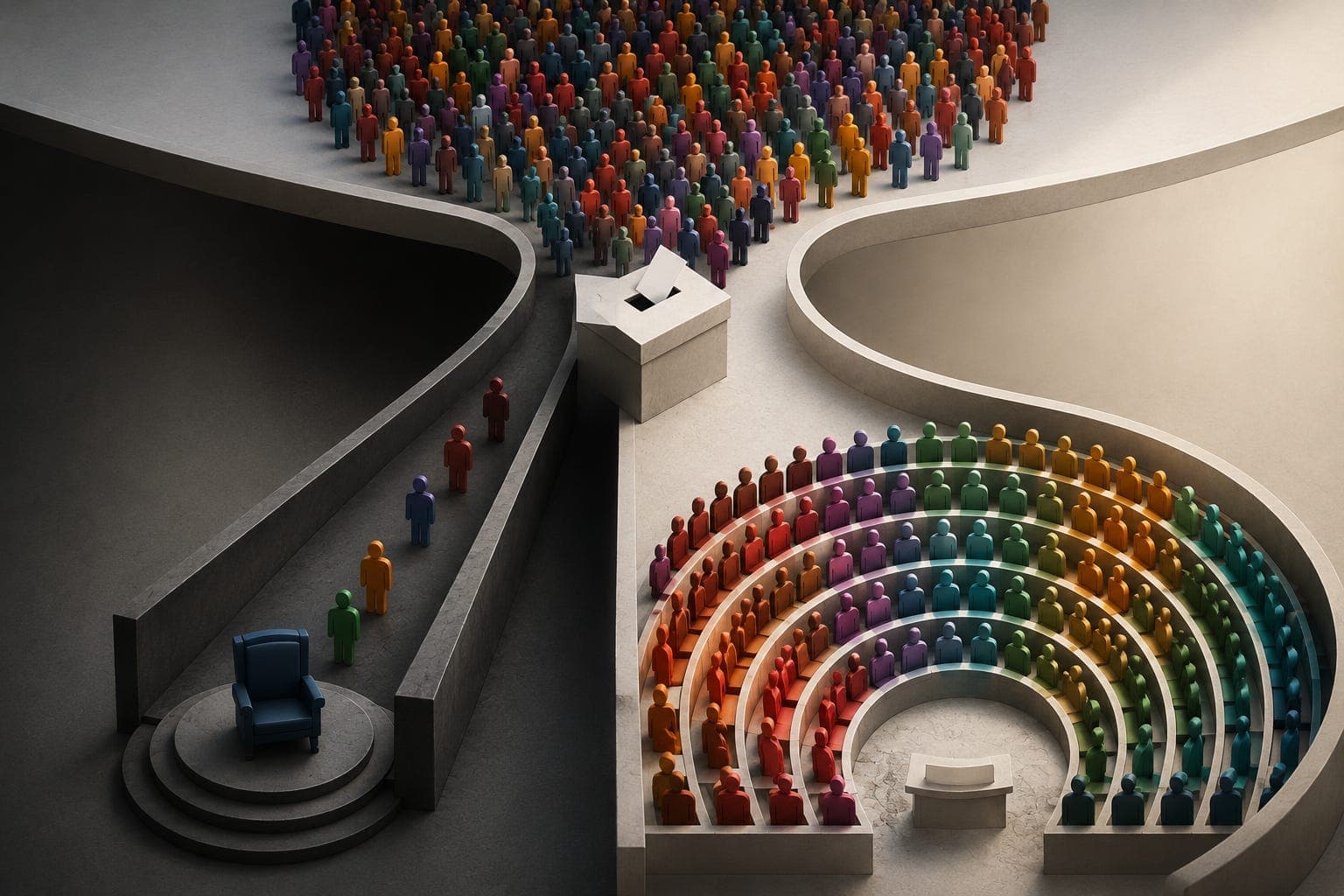
The geometry a vote is counted under is fixed before any vote is cast. It is not chosen by the voter, it is not adjusted for the result, and it, far more than the campaign, decides how a distribution of votes becomes a distribution of seats. This is the structural variable, and it is routinely treated as part of the furniture rather than as a choice with consequences.
There are two design questions here, and almost every public argument about electoral systems collapses them into one. The first is how districts are drawn: whether a jurisdiction elects one member per district or several. The second is how a voter expresses a choice on the ballot: whether by marking a single candidate, as under first past the post, or by ranking them in order of preference. These are separate axes. A system can be single-member and preferential, which is what the House of Assembly is, or multi-member and preferential, or single-member and non-preferential, and the four combinations behave differently.
Australia shows plainly that the two axes are independent, because it runs them in every combination at once. Preferential voting is universal here. It is used for the single-member House of Assembly and for multi-member chambers alike. And multi-member proportional lower houses already exist on home soil: Tasmania and the Australian Capital Territory have elected their lower houses by the multi-member Hare-Clark method for decades, on preferential ballots. The proportionality those chambers produce does not come from the preferential ballot, which they share with the single-member chambers that are not proportional at all. It comes from the multi-member districting. The live variable for proportionality is the geometry of the districts. The ballot is a separate matter, and keeping the two apart is the distinction this analysis turns on.
That distinction can be demonstrated rather than asserted, because South Australia came as close to running the experiment as electoral politics allows. On 21 March its voters marked two ballots. The House of Assembly counted one under single-member districting. The Legislative Council counted the other, drawn from the same electorate on the same day, under multi-member proportional representation. One population, one moment, two counting geometries. No comparison between countries comes near it. A cross-country comparison has to hold a hundred things constant that differ between nations: political culture, the party system, the salience of any given issue in any given week. Textbook treatments reach for examples from different decades and different countries and ask the reader to assume the rest is equal. Here almost nothing has to be assumed. The same electorate, in the same hour, was sorted into seats twice, by two different rules, and the two answers came out different.
It is not a laboratory, and the one impurity is worth stating, because it deepens the point rather than weakening it. Voters marked two different ballots, and the party shares differed a little between them: One Nation drew 22.9 per cent in the House and 24.43 in the Council. Some of that gap is a known effect. A voter who understands that a minor-party first preference is likely wasted in a single-member seat, but can elect someone in a proportional count, has reason to vote more cautiously on the one ballot and more freely on the other. Where that happens the geometry is not only sorting the votes; it is shaping them before they are cast, holding down the very support it then under-represents. The House figure, if anything, understates One Nation’s real strength, which makes the seat comparison that follows the conservative reading rather than the contaminated one. The electorate barely moved between the two ballots. The geometry did the rest.
Watch One Nation move across the two chambers. In the House, 22.9 per cent of the primary vote became four seats out of forty-seven, which is 8.5 per cent of the chamber. In the Council, 24.43 per cent of the primary vote drew 2.93 quotas and returned three of the eleven seats contested, close to a quarter of them and near enough to its vote share that the gap is rounding rather than distortion. A quarter of the first preferences converted into a twelfth of one chamber and a quarter of the other, on the same day, from the same electorate. The decisive change between the two counts was how the districts were drawn.
Now watch the Greens, because the symmetry is the whole point. In the House the Greens drew 10.4 per cent of the primary vote and won nothing at all. In the Council they drew 10.20 per cent, 1.22 quotas, and returned one of the eleven seats, again near their share. A party of the populist right and a party of the environmental left, sitting at opposite ends of the spectrum, were each erased by single-member geometry and each represented under proportional geometry, in the same election, by the same voters. The distortion, measured against the equal weight of every vote, does not pick sides on the spectrum, and a reader tempted to welcome one of those erasures and resent the other is being shown precisely the thing the argument is about. But it is not directionless. It has a side, and the side is not ideological: it is the shape of a party’s support on the map. Single-member districting rewards a vote concentrated enough to carry particular districts and punishes one spread too evenly to carry any, whatever the party believes, and whatever its size. That is why a tenth of the vote, dispersed, won the Greens nothing, while One Nation’s vote, banked in particular seats, won four. What the geometry entrenches is not the right or the left, and it is not even the incumbent: the Liberals were an incumbent major party, and single-member districting did not save them. It is the concentrated against the dispersed.
Set the two conversions beside each other and the pattern is unmistakable. Under single-member districting a quarter of the vote on the right became a twelfth of the chamber, and a tenth of the vote on the left became none of it. Under proportional districting, applied to the same electorate hours earlier, each of those parties landed within rounding distance of its vote share. Both chambers used preferential ballots rather than first past the post; that much they had in common. They did not use the same ballot. The House compels a full ranking of every candidate; the Council lets a voter mark a single party box above the line and stop. That difference runs the wrong way for anyone wanting to credit the ballot with the fair result. The chamber that produced proportionality was the one with the weaker preferential machinery. So it was not the preferences that did the work. The districting was the difference, and it accounts for the result.
The single-member geometry is unforgiving at the margin in a second way worth noting. In Narungga the seat was decided by 58 votes after a recount and formal declaration. Close contests occur under any system, but single-member districting gives them a particular weight: a handful of voters flips an entire seat outright, with no compensating count elsewhere to absorb the swing, where a knife-edge final seat in a proportional chamber barely moves the overall shape of the result. A handful of voters, rather than a settled balance of opinion across the state, can turn a single-member outcome. That sits alongside the larger pattern as part of the same structural fact: what decided who held which seats, across both chambers and at the knife-edge, was how the districts were drawn.
That is the diagnosis. What follows is the harder ground, where the evidence is thinner and runs in both directions, and the discipline is to say so.
Start with who benefits from the system as it stands, because that is the part that is firmly established. Single-member districting rewards the party whose vote is distributed most efficiently across districts, and in South Australia that party was Labor: 37.5 per cent of the House primary vote translated into 72.3 per cent of the seats. This is structural, not a charge of manipulation. Labor drew the benefit of a geometry it did not design, in the same way One Nation and the Greens drew its cost. Naming the beneficiary of a structure is not the same as attributing a motive to it, and the distinction holds throughout.
It is worth being exact about the word I have been using. To call the single-member result a distortion is to measure it against one standard, the equal weight of every vote, and to find it wanting by that standard. Single-member districting answers to a different standard, and was built to: it trades proportionality for a single identifiable local member and for the tendency to manufacture a governing majority out of a divided vote. Those are real goods, and a defender of the system is not obliged to apologise for them. The distortion is therefore not a malfunction. It is the price the system pays, by design, for the goods it is built to deliver. The argument here is only that the price is real, has now been demonstrated, and has been kept out of public view. What it is not is free.
Now turn to the remedy, and the case weakens immediately. The literature attributing social goods to proportional representation, the long list associated with Arend Lijphart, is attractive: policy closer to the median voter, greater satisfaction with democratic institutions, more women in parliament, lower income inequality, less military spending, lower carbon emissions. The difficulty is not that the list is short. It is that none of it is shown to be caused by proportional representation. The evidence rests substantially on correlations between countries, and a country that runs proportional representation differs from one that does not in many ways at once, any of which might be doing the work. Adrian Vatter, examining the claim across thirty-three democracies with the controls the bare correlations lack, found it holds only in part: proportional systems do better on representation, but not robustly on participation, on transparency, or on the capacity to govern. The objection Cox and others press is that institution and outcome may share a prior cause, so that the correlation records that cause rather than an effect of the system. This is the problem the series met one article ago, where the examination of media ownership found no clean causal link between diverse ownership and diverse content, and rested its case on structural and democratic ground rather than a demonstrated effect on output. The shape recurs, and it would be a failure of this analysis to present the benefit case as though it were clean.
The costs attributed to proportional representation are contested in exactly the same way, and it would be just as much a failure to present them as settled. The standard charges are coalition instability, a lowered threshold that lets fringe and populist parties into the chamber, and a weakened line of accountability between a voter and a single identifiable representative. Each is argued seriously. The historical exhibit for the fringe-party charge is Weimar Germany; the contemporary one is the rise of the Sweden Democrats, who grew under proportional representation from no seats to around a fifth of the vote and second place. But the charge does not run cleanly either. Multiparty systems may contain extremism rather than feed it: a fringe party can take its proportional share of seats without capturing a major party, and a losing side that has been represented has less cause to reject the result. The research into whether proportionality drives parties toward the extremes, examined across first eighteen and then thirty-one countries, found no such effect. So the ledger does not resolve into a clean column of goods or a clean column of harms. It stays genuinely open on both sides.
South Australia adds a finding that complicates any tidy story further. In the Council count, 94.18 per cent of voters marked the ballot above the line, and 64.3 per cent of the preferences distributed in the deciding stages exhausted before electing anyone. The proportional outcome was reached with the preferential machinery barely engaged; Antony Green’s assessment is that the chamber effectively behaves as list proportional representation, allocating seats by party share rather than by the flow of preferences. The proportionality came from the multi-member districting, and the preferences did little of the work. This cuts against an intuition that the elaborate preferential ballot is what delivers fair representation. On this evidence it was not.
The finding here is the symmetry itself. The diagnosis is firm: the geometry distorts, demonstrably and without favour to right or left. The remedy is contested in both directions: the goods claimed for proportional representation are not established, and neither are the harms. Saying both halves plainly, rather than resolving the second into whichever answer the diagnosis seems to invite, is the integrity of the argument.
I should declare an interest and then put it under the same light. The most developed counter-architecture in this area belongs to John Macgregor’s The Mechanics of Changing the World, whose programme for renovating the democratic machinery (the part of the book that turns to electoral reform, distinct from the media architecture an earlier article in this series examined) pairs proportional representation with preferential voting as mutually reinforcing. The book puts the claim directly: proportionality is usually enhanced by a preferential voting system. It is a programme I support, and that is exactly why I am obliged to say where the South Australian evidence does not support it. The proportionality in the Council came from the multi-member districting. The preferential ballot, with 94 per cent of voters going above the line and most distributed preferences exhausting, did almost none of the work the pairing credits to it.
I should be as careful with that finding as with the others. It is a single case, and the South Australian Council is the configuration least favourable to preferences: optional, dominated by the party box above the line, the flow of preferences barely engaged. A full-preferential system such as Tasmania’s or the Territory’s Hare-Clark, where every preference must be marked and counted, would be the fairer test of whether the pairing holds, and this article has not run it. So the statement has to be bounded: the one local test available does not corroborate the claim that the preferential ballot enhances proportionality, and it qualifies a position I hold rather than overturning it. That is the discipline this series asks of everyone else’s remedies, and it cannot exempt the one I happen to find congenial.
The sharpest test of whether this argument is being made evenly is the one it is most tempted to dodge. The most conspicuous beneficiary of proportional representation in Australia today is One Nation. A party arriving in a chamber at close to its actual vote share is the mechanism working as intended, not failing. If proportional representation is good because it translates votes into seats faithfully, then it is good when it does so for a bloc the writer or the reader would rather not see represented. The reader’s feelings about One Nation are the cleanest available test of whether this case is being argued on principle or on preference. The Greens, erased at the other end of the spectrum by the same single-member geometry, are the same test in the opposite direction. Both readings have to carry equal weight, or the argument was never about geometry.
What stands, with the inversion, the dual-chamber contrast and the contested remedy all in view, is a diagnosis rather than a programme. Counting geometry is upstream of the result. Single-member districting imposes a distortion that has been demonstrated here inside a single election, across both ends of the political spectrum, and it is therefore not neutral. One thing follows, and a reader who has followed the argument can arrive at it independently: single-member districting is not a costless default but a choice with a cost, and the burden it has long enjoyed, to be assumed rather than justified, no longer holds. What must be defended is the system on its merits against its now-visible cost, not the pretence that it has no cost.
That is as far as the evidence reaches, and it is important not to walk past the line. Whether the answer is proportional representation is a separate question, and the evidence assembled here does not settle it, because the case for that remedy is genuinely contested in both directions. To close by asserting that Australia should adopt proportional representation would be to claim more than has been shown, and to convert an analysis into a brief. My own values do not resolve the question either. Decision-making kept as close as possible to the people affected is the case for single-member districting and its local representative. The equal weight of every vote is the case against it. Those commitments pull in opposite directions on this question, and that is the reason this article diagnoses the distortion precisely and stops there, rather than prescribing the cure.
Walker Briefing is a reader-supported publication. To receive new posts and support my work, consider becoming a free or paid subscriber.

Written by
Hon Dr Brian Walker MLC
MB ChB · MRCGP · FRACGP · 45+ years as a GP
Brian Walker is a General Practitioner and Member for Western Australia in the WA Legislative Council. He is the Leader of the Legalise Cannabis Party WA and an advocate for evidence-based cannabis reform, healthcare improvement, and progressive policy in WA.
Share this article
Stay Updated
Get the latest news and parliamentary updates delivered to your inbox