The Three Flags Conundrum
Did you ever wonder why you have the opinions you hold? Let’s look at an example of how we are being conditioned to think, or how we see the world. Ready? Just recently we had two delegations from our Federal parliament visit Beijing and Taipei. The West Australian published an article here on Thurs
Brian Walker
Did you ever wonder why you have the opinions you hold? Let’s look at an example of how we are being conditioned to think, or how we see the world. Ready?
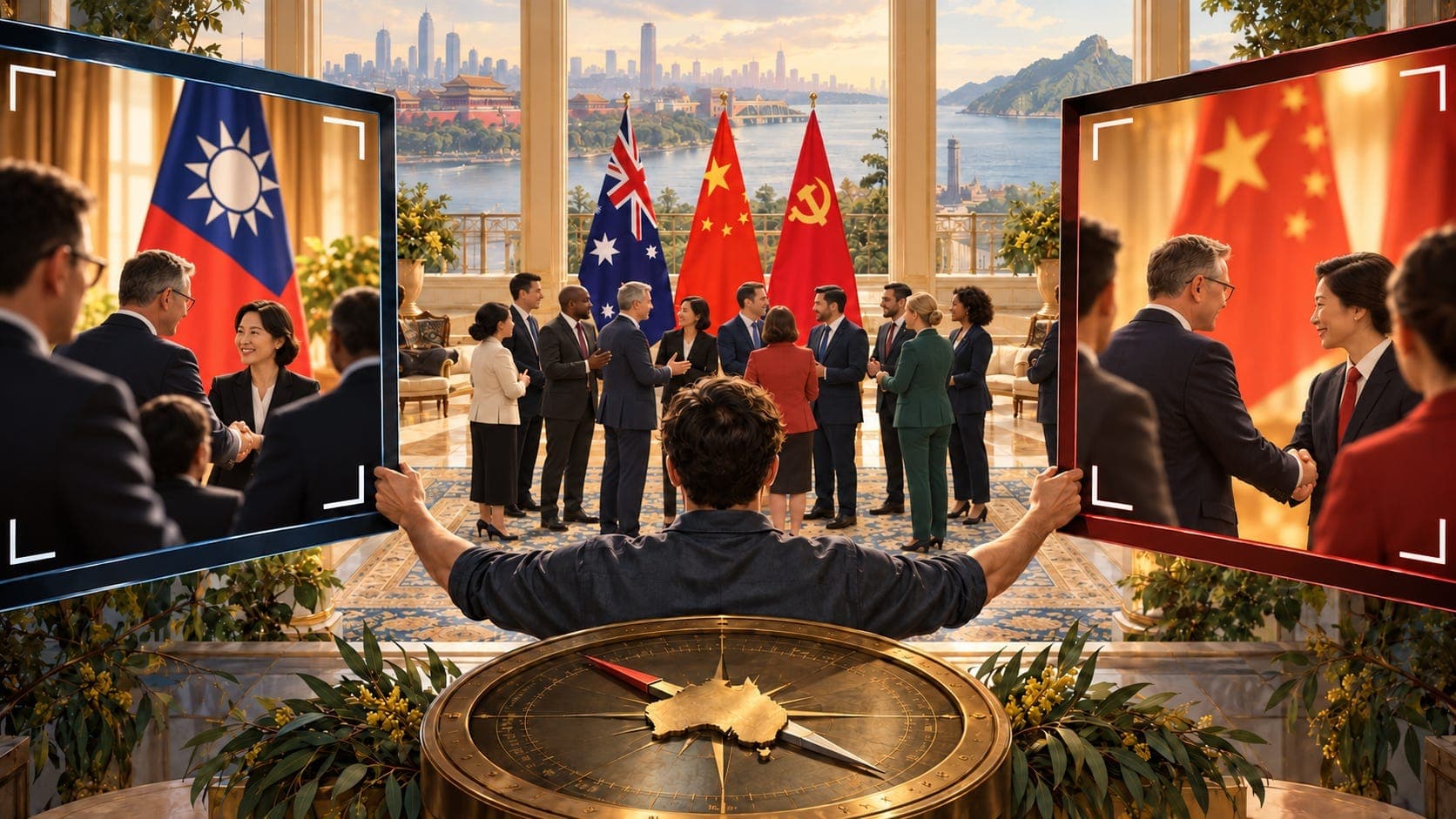
Just recently we had two delegations from our Federal parliament visit Beijing and Taipei. The West Australian published an article here on Thursday 24 September. Look at the photograph that ran with the story. A group of Australian parliamentarians, from both sides of the House, stand in a row in a reception room in Beijing. Behind them are three flags. One is ours. One is the national flag of the People’s Republic of China. The third is the flag of the Chinese Communist Party.
Walker Briefing is a reader-supported publication. To receive new posts and support my work, consider becoming a free or paid subscriber.
Now read the sentence under it. The delegation, the report said, “posed for pictures in front of the Communist Party flag”.
That sentence is true. There was a Party flag. But there were three flags in the picture, and the story chose one. The national flags of both Australia and China were standing right there, a metre away, and did not rate a mention.
There was no lie, but did you wonder why that wording was chosen? This is the harder question. Why did one flag make the sentence and two did not? And what did you feel when you read it? If you felt a small chill, you are not alone. That chill is the point of this piece. Now think about it with some critical thinking skills, the skills our schools barely teach.
The week in full
So what actually happened?
A cross-party delegation of federal members, led by the Speaker of the House of Representatives, went to Beijing. On Sunday the twentieth they were received by the head of the Communist Party’s International Department, the arm of the Party that deals with foreign political parties. This photograph was taken at that meeting.
It was not the only meeting. The same day, according to China’s state news agency, the Speaker sat down in the Great Hall of the People with the chairman of the Standing Committee of the National People’s Congress. That is China’s legislature, and its chairman is the Speaker’s nearest equivalent. Then on the Monday the Speaker met China’s Vice President. Parliament to parliament first, and then a meeting with the Chinese state. This story did not mention either meeting.
In the same week a second group of federal parliamentarians was in Taipei. It was led by the Deputy President of the Senate, a senator from WA, who spoke of the “shared geopolitical challenges” Australia and Taiwan face, and whose hosts thanked Australia for its “long-standing friendship and support”. Not only did the story report that trip as well, but it reported in noticeably warmer language. Taiwan was “the democratic island”.
Two delegations from Federal parliament in the same week, doing what parliament has done for a very long time. Working on bilateral relationships, bearing in mind that politics at its core is about cultivating relationships. On that basis the Speaker’s office confirmed that delegations have been travelling to China “for decades” as part of a regular programme, as we do for Taiwan. None of this is new, none of it is secret, and this is a normal part of what a country with interests in both places does.
The question is not whether these visits should happen. It is why one of them reads as a warning.
What was fair, and what was not
This was a regular journalistic piece about parliamentary travel, quoting Speaker’s office for official reporting. Both trips were accurately reported, and both places are of interest to Australia. It is entirely legitimate to ask questions about Australian members meeting the officials of the countries they visit. Those officials with whom they meet also have legitimate concerns and relationships to build, and our diplomatic efforts are a mainstay of ensuring geopolitical relationships and, ultimately, maintaining peace in our region and the world. So they met with the Communist Party’s International Department, a department whose work sits close to the Chinese government’s efforts to build influence abroad. We have passed in this country foreign interference laws in 2018 for good reasons, much like their equivalent in China. Scrutiny is not the problem. A free press asking who met whom is doing its job.
No, scrutiny is not the problem. What is a problem is found in two sentences that told you nothing about the visit.
The first told you that three of the Labor members on the trip “all have strong Chinese diasporas in their electorates, while Dr Garland serves as a Chair of the Parliamentary Friends of China group in Canberra”. The second half of that sentence is fair context: a member who chairs a friendship group has an obvious reason to be on the trip. The first half is something else. It is true, and it is also true of many electorates across Sydney and Melbourne. So why is it there? What is it doing in a story about a meeting in Beijing? Go back over it and ask yourself what it invites you to think about those three members, and about the people who elected them.
The second told you that none of the delegation had posted pictures of the meeting on social media, although they post about fuel security and the football. An absence has been placed in front of you as though it were evidence. Of what? The sentence does not say, it does not have to say anything because the silence is the implication. Our marvellous brains are designed to recognise patterns, to fill in the gaps, much like when you see a line drawing with empty spaces which nevertheless allow your eyes to perceive a picture. You fill the gap yourself, and the gap you have been given is shaped like a secret.
We have seen where this leads. In 2020 a Senate committee held an inquiry into issues facing diaspora communities. Three Chinese-Australian witnesses came to give evidence, and one senator asked each of them whether they were “willing to unconditionally condemn the Chinese Communist Party dictatorship”. One called the experience jarring. One refused to answer and later called the question demeaning. And at least one other person decided not to give evidence at a later hearing. That is what the loyalty question does. It does not catch spies. It teaches Australians of Chinese heritage that the price of speaking in public is to prove which side they are on, even if there is no side to choose.
Neither of those two sentences in that report is an accusation and that is exactly why they work.
The other side’s telling
Now turn the photograph around and look at how Beijing reported the same four days.
China’s state news agency carried the meetings with the legislature’s chairman and the Vice President. Every line is warm. China is “willing to work with Australia”. The two countries will build a “more mature, stable and productive” partnership. The Speaker is reported as saying Australia “adheres to the one-China policy” and wants closer cooperation on trade, agriculture, mining, climate and artificial intelligence. There is no disagreement anywhere in it. There is no Taipei delegation. There is no mention that anyone in Australia has a concern about anything.
That is selection too, and it runs the other way. Taipei’s officials did much the same for their visitors, thanking Australia for its “long-standing friendship and support”. Official accounts, on either side, tell you what the host wants you to hear.
And yet there is a word worth noticing. In the state agency’s account of the meeting with the legislature’s chairman, the Speaker said Australia adheres to the one-China “policy”. In the Party department’s own summary of its meeting, as translated in the Australian report, it is “all Australian political parties have long adhered to the one-China principle”.
Policy. Principle. One word. It matters more than it looks.
When Australia recognised the People’s Republic in 1972, our Government recognised it as “the sole legal Government of China”, and it “acknowledges the position of the Chinese Government that Taiwan is a province of the People’s Republic of China”. Acknowledges. Not agrees with. That word was chosen with great care more than fifty years ago, and every Australian government since has kept it. It means we know what Beijing says about Taiwan, and we have not said it ourselves. Beijing’s one-China principle goes further: it states that Taiwan is part of China. Australia’s one-China policy does not.
Those were two different meetings, and nobody needs to have changed anything. Both of the state news agency’s reports say “policy”. But when the Party’s own department summed up the visit in its own voice, it reached for the Party’s word, not ours. That difference sits at the heart of Australia’s careful position on the most challenging question in our region. If you only read the Party’s summary, you would think we had signed up to something we never have.
A free newspaper choosing what to put in a story and a state news agency answering to a ruling party are not the same thing, but the mechanism is the same. Each picks the parts of the story that fit the politics, and leaves you with a picture that is true in every detail and yet still false.
Two boxes
Now put the two accounts side by side and look at what they offer you.
One says: engagement with Beijing is suspect. Mind the flag. Mind who these members represent. Mind what they did not post. It recruits a small, low anxiety, the kind that asks whose side people are really on.
The other says: engagement is endorsement. Australia agrees. The relationship is warm and nothing is in dispute. It recruits reassurance, and the feeling that the question has already been settled.
I constantly harp on about the false dichotomies that we are being force fed. The false belief that there are two sides, and my side is the correct side so choose. In this case it is suspicion or endorsement. Good state or bad state. One of “us” or not one of “us”. Those are the two boxes. Many stories you will read about China this year will ask you, without saying so, to step into one of them.
Now beware! Both boxes are wrong, because Australia does not live in either. We are a sovereign country with our own interests. We trade with China more than with anyone. Our largest customer for iron ore is China, the shipping routes lead through the South China Sea to China. While we have an alliance with the United States that shapes much of our defence, we also have long friendships across the region, China and Taiwan among them. Our own foreign policy, written in 1972 and kept by every government since, lets us deal with Beijing and with Taipei at the same time, on our terms, in our interest. The same Speaker told his Chinese counterpart that Australia adheres to the one-China policy, in the same week his colleagues were being thanked for their friendship in Taipei. That is not a contradiction but rather a political approach undertaken by a country that makes its own decisions.
The two-box frame damages exactly that freedom to decide. It turns a question of interest into a question of loyalty and shows us a people that has been taught to ask “whose side are you on?” rather than asking “what is good for us?”
Where I stand on Beijing
Where do I stand on this?
Independence means independence from everyone and being able to form relationships that benefit our country without ceding authority or freedom. I have argued for years that Australia should not be a junior partner that says yes to Washington and keeps quiet when trouble comes. The same rule applies to Beijing, and I apply it.
China punished Australian farmers and winemakers, in a campaign that escalated sharply after our Government called for an inquiry into the origins of COVID. In my opinion, our Government was making that call on behalf of the USA. Either way, the trade penalties on our barley and our wine were coercion, and they were meant to be seen as such. China’s expansion across the South China Sea has pushed the Philippines and Vietnam around with ships and water cannon, not with argument. When the Philippines took its case to an international tribunal in 2016, the tribunal found that China’s sweeping claims to those waters had no basis in law. Those are not the actions of a partner that respects the sovereignty of smaller countries. I would say this is unacceptable in Canberra as well as in Beijing.
None of that makes the two-box frame any more accurate. You can criticise the Chinese Government without being told to fear Australians of Chinese heritage. You can want peace with China without being told you have signed up to its view of Taiwan. Holding both of those at once is not fence-sitting. It is the ordinary work of critical thinking.
You are already out of the boxes
Now the good news, and it is real.
Every year the Lowy Institute asks Australians what they think about the world. This year’s poll was taken in March. Trust in the United States to act responsibly fell to thirty-one per cent, the lowest the poll has ever recorded. Trust in China rose to twenty-eight per cent. Four years ago the gap between them was fifty-three points. Now it is three. Sixty-one per cent of Australians said they see China more as an economic partner than as a security threat. Just over half said our relationship with China is more important than our relationship with America. And two-thirds still support the submarines.
Those numbers do not describe a people in two boxes. They describe a people holding several things at once: wary of both great powers, practical about trade, behind the submarines, and, as I set out last week, unwilling in the majority to send our sons and daughters to fight over Taiwan. That is not confusion. That is judgement.
The public has moved. Much of the coverage has not and much of what you read about China is still written for a readership that sorted itself into two camps years ago and stayed there. You are not that readership any more, if you ever were.
What you have not been given is the habit that would let you see it for yourself, every time, without needing me or anyone else to point it out.
Three questions
So, the habit. It starts at the moment you notice the chill. Stop there and ask yourself what you are being asked to feel. Then ask three questions. They work on any story about China, or Taiwan, or America, or anything else someone would like you to feel strongly about before you have thought about it.
1. What’s missing?
Every story is a selection, so ask what was left outside the frame.
2. What’s been linked that isn’t linked?
Watch for two things placed side by side so that one seems to explain the other.
3. Who says it’s one or the other?
When a story offers you only two positions, ask who decided those were the only two.
Try them on the photograph at the top of this page. What’s missing? Two flags, and two meetings with the Chinese state that nobody mentioned. What’s been linked? A member’s electorate and their loyalty, a flag on a wall and an allegiance in a heart. Nobody said those things belong together; the sentence just put them next to each other and let you do the rest. Who says it’s one or the other? Not our own foreign policy, which since 1972 has let us deal with both. And not the people of this country, whose answers to the pollsters fit neither box. What is left, once the questions are asked, is the thing neither account showed you: a sovereign country dealing with a large and difficult neighbour on its own terms.
This habit should not depend on whether you happen to read my Substack. It should be taught in our schools, from early on, as plainly as reading and arithmetic. How a story is built. How a number is chosen. How a feeling is recruited before a fact is offered. A country that wants to make its own decisions needs citizens who can see when a decision is being made for them.
The consent we were never asked for
Last week I wrote about AUKUS and informed consent: how the people of this State have been told the benefits and never properly told the risks, and never asked whether they agree. This is part of how that happens. Not through lies. But through selection. Through a steady diet of stories that tell you which box to stand in, until the question of what is good for Australia stops being asked at all.
Every picture has more in it than the caption tells you. Next time you are handed one flag, look for the other two.
Walker Briefing is a reader-supported publication. To receive new posts and support my work, consider becoming a free or paid subscriber.

Written by
Hon Dr Brian Walker MLC
MB ChB · MRCGP · FRACGP · 45+ years as a GP
Brian Walker is a General Practitioner and Member for Western Australia in the WA Legislative Council. He is the Leader of the Legalise Cannabis Party WA and an advocate for evidence-based cannabis reform, healthcare improvement, and progressive policy in WA.
Share this article
Stay Updated
Get the latest news and parliamentary updates delivered to your inbox