When Spectacle Crowds Out Stewardship
Walker Briefing
Brian Walker
Walker Briefing is a reader-supported publication. To receive new posts and support my work, consider becoming a free or paid subscriber.
For the better part of several weeks, Western Australia has spoken in one voice. It has spoken in maroon and blue.
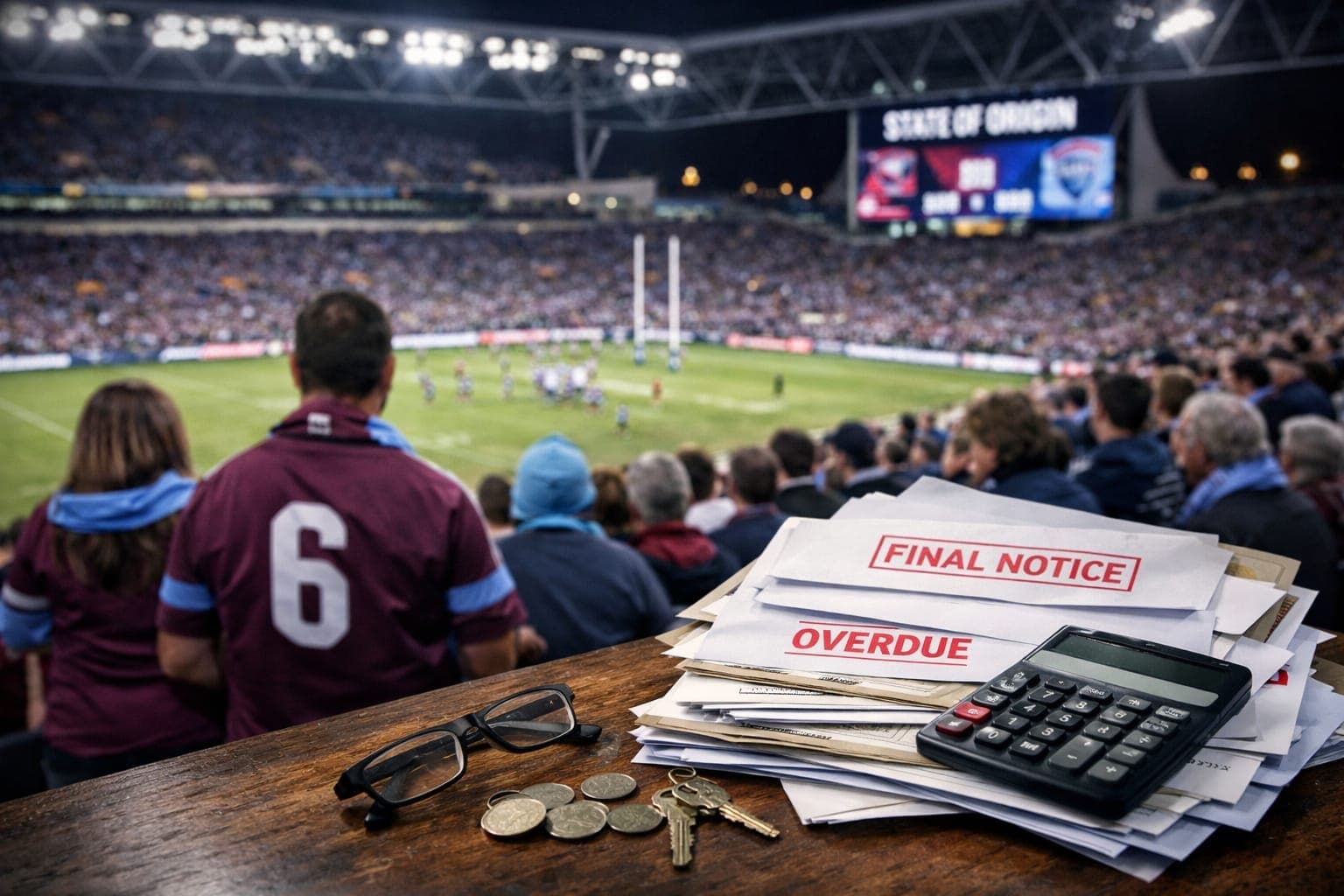
State of Origin has dominated conversation in cafes, workplaces, schools, parliamentary corridors, and social media feeds. Advertising cycles have revolved around it. News bulletins have led with it. Post-match analysis has extended for days. The emotional temperature has risen and fallen with each result.
There is nothing inherently wrong with this. Sport binds communities. It creates ritual, identity, and shared experience. It is, at its best, a form of cultural glue. But there is a question worth asking, and it is not about football.
What does it mean when a single sporting event commands more sustained national attention than the structural conditions shaping the lives of millions of Australians?
Attention is not infinite. It is a civic resource. And like all scarce resources, how it is allocated matters.
The Allocation of Attention
Modern democracies do not function solely through votes and laws. They function through attention. What citizens notice, discuss, and dwell upon determines what institutions must respond to. Persistent attention drives reform. Fleeting attention produces gesture.
In an environment saturated by media, attention is no longer merely organic. It is curated, amplified, and, above all, measured. Emotional intensity translates into engagement. Engagement translates into visibility. Visibility translates into revenue and influence.
It is not necessary to assume coordination or conspiracy to observe this. Incentives are sufficient. Content that provokes strong feeling will travel further and faster than content that demands slow reflection. This is not a moral judgement. It is an economic one.
Sport is ideally suited to such an environment. It offers tribal clarity without existential consequence. It generates outrage that dissipates within days. It creates winners and losers without destabilising the system that contains it. It is emotionally satisfying and structurally harmless.
Structural economic reform, by contrast, is none of these things. It is slow, complex, and often uncomfortable. It lacks the clarity of a scoreboard. It does not lend itself to simple moral binaries. It rarely produces immediate catharsis.
In an attention economy, the former will always outcompete the latter.
The issue, then, is not that sport exists. It is that structural questions struggle to secure sustained space within the same ecosystem.
What Rarely Dominates the Cycle
Consider the working poor.
Across Western Australia, employment no longer guarantees security. A person working full-time in hospitality, retail, or aged care can earn $55,000 to $65,000 a year and still find themselves in housing stress. The median weekly house rent in Perth reached a record $700 in 2025, having risen roughly 90 per cent since 2020. For a full-time hospitality worker, rent alone can consume more than 40 per cent of gross income. That is not a lifestyle inconvenience. It is structural precarity built into the design of the labour market.
The Bankwest Curtin Economics Centre reported in 2025 that 210,000 Western Australian households now consider their housing unaffordable, a 91 per cent increase since 2022. Only 39 per cent of WA renters describe their housing costs as affordable. Affordable rentals priced below $350 per week have dropped 82 per cent since 2020. The social housing waitlist has grown to nearly 20,700 applicants, with the priority list expanding by 330 per cent in six years. Rough sleeping has risen 114 per cent since 2016. One in ten specialist homelessness service clients is now employed.
These are not peripheral statistics. They describe a structural condition in which work no longer reliably provides shelter, and in which the gap between wages and essential costs continues to widen. National wage growth sits at 3.4 per cent. Perth rents rose by roughly 14 per cent annually in each of the three years following the pandemic. The arithmetic is not complicated. When housing costs rise four times faster than wages, year after year, the result is not a temporary squeeze. It is a systemic transfer of wealth from those who work for a living to those who own the assets they depend upon.
What makes this particularly corrosive is that it proceeds invisibly. There is no single event, no dramatic rupture. A nurse does not lose her home on a particular Tuesday. She simply finds, month by month, that the distance between what she earns and what she needs widens fractionally, until the cumulative effect becomes unmanageable. A young tradesman does not fail spectacularly. He simply never reaches the threshold at which home ownership becomes possible, despite working full-time in a state experiencing a construction boom. The crisis is not episodic. It is architectural.
Yet these conditions rarely dominate public attention for weeks at a time. They surface briefly in data releases, political exchanges, or advocacy reports, and then recede.
Why?
Part of the answer lies in complexity. Structural economic design is difficult to narrate. It lacks the immediacy of a contest. It does not offer the emotional simplicity of rivalry.
But part of the answer lies in incentive structure. Stories that sustain attention must generate reaction. Reaction drives engagement. Engagement drives amplification. The structural causes of working poverty do not produce immediate emotional spikes. They produce gradual erosion. And gradual erosion does not trend.
Speed and the Compression of Deliberation
There is another dimension to this.
The speed of modern communication compresses deliberation. Issues rise and fall within hours. Outrage cycles complete themselves before policy responses can be formed. Reaction substitutes for analysis.
In such an environment, the capacity to dwell on structural questions weakens. It is difficult to sustain collective focus on long-horizon reform when the next emotionally charged event is always seconds away.
Speed favours spectacle. Slowness favours stewardship.
Democratic reform requires patience, but attention economies reward immediacy. The result is a subtle but persistent distortion. Not a dramatic one. Not a coordinated one. But cumulative.
We become accustomed to intensity without depth.
That sentence deserves a moment. It describes not a conspiracy, but a habit. A habit shaped by an environment in which the loudest signal always wins, and in which the quietest problems, the ones that erode lives gradually rather than dramatically, receive the least sustained scrutiny.
What Falls from View
This distortion is not confined to domestic economics.
The same attention dynamics that prevent sustained focus on working poverty also shape how Australians engage with the wider world. And the connection is not merely analogical. It is structural. The incentive systems that make housing policy boring and football exciting are the same systems that make humanitarian catastrophe exhausting and geopolitical risk abstract. The pattern is consistent: issues that require moral seriousness, historical context, and sustained emotional stamina lose ground to those that offer rapid emotional release.
This matters for a country like Australia, whose prosperity depends on global trade, whose security depends on alliance management, and whose democratic legitimacy depends on informed consent to the foreign policy conducted in its name. If citizens cannot sustain attention on the international conditions that shape their economic and strategic environment, democratic oversight of those conditions weakens. And that weakening proceeds as quietly as the erosion of housing affordability.
Consider Gaza. Since October 2023, more than 73,000 people have been killed. Independent studies, including research published by the United Nations Office of the High Commissioner for Human Rights, indicate that approximately 70 per cent of Palestinians killed in residential buildings were women and children. This is a humanitarian catastrophe of historic scale, unfolding in a territory smaller than metropolitan Perth. It has not ended. People continue to die from injuries, disease, and the collapse of medical infrastructure.
Yet in Australian media, Gaza has moved from front-page urgency to intermittent mention. The conflict has not resolved. The killing has not stopped. What has changed is attention.
Or consider the significant naval deployments to the waters near Iran, carrying genuine escalation risk for energy markets, regional stability, and alliance obligations that directly affect Australia. These developments are documented and publicly reported. They rarely anchor sustained domestic discussion.
The question in each case is not motive. It is allocation.
Humanitarian catastrophe is exhausting. It demands moral stamina that the attention economy is structurally unable to sustain. Strategic risk requires context and historical understanding. Neither lends itself easily to rapid consumption.
When attention cycles move quickly, stories that require sustained seriousness lose ground. They do not disappear. They flicker. And when public attention skims across crises without dwelling, democratic pressure attenuates. Policy responses become reactive rather than anticipatory. Long-term risk accumulates quietly.
Performative Energy and Policy Substance
Incentive structures shape not only media but politics itself.
Visible signalling is more easily rewarded than incremental reform. Public performance can substitute for measurable outcome if attention cycles are short enough. This is familiar to anyone who has observed the difference between a policy announcement and its implementation. An announcement generates a headline. Implementation generates a spreadsheet. The headline circulates. The spreadsheet does not.
I have watched this from inside parliament. A minister can announce a housing initiative and receive a full news cycle of coverage. The question of whether that initiative produces dwellings at the scale required to close a shortfall of 4,000 homes per year receives, at best, a data release months later that surfaces briefly and disappears. The announcement was rewarded. The outcome was barely measured in public.
This is not a moral failing of individual politicians. It is a structural one. When citizens reward visibility over durability, institutions will respond accordingly. When attention spans compress, the incentive to announce outweighs the incentive to deliver. And the gap between performance and substance widens without anyone noticing, because noticing requires the very sustained attention that the system has already consumed.
The same dynamic operates in reverse. When a policy quietly fails, when a programme designed to address homelessness produces fewer dwellings than projected, when a workforce strategy does not produce the tradespeople required, the absence of sustained coverage means the absence of sustained accountability. The failure does not register as an event. It registers, if at all, as a statistic in a report that few will read and fewer will discuss for more than a day. This is not because citizens do not care. It is because the environment in which they form their concerns is optimised to capture their attention with other things.
The Cost of Disproportion
The danger is not that we enjoy sport. It is that we lose proportion.
A healthy society can celebrate ritual and still scrutinise governance. It can engage emotionally without surrendering judgement. It can allocate attention broadly enough to encompass both spectacle and structure.
But proportion does not emerge automatically in an environment optimised for engagement. It requires discipline.
If the working poor receive less sustained attention than a sporting rivalry, the imbalance has consequences. If a humanitarian catastrophe producing tens of thousands of civilian deaths fades from coverage while the killing continues, the consequences are graver still. If structural economic design is debated only intermittently, reform stalls. And if the gap between announcement and delivery is never held to account, governance becomes a performance rather than a practice.
Democracies depend on citizens who can resist the pull of disproportion. Not by rejecting emotion, but by refusing to let emotion monopolise the space where judgement is required.
Composure and Democratic Maturity
Composure is not passivity. It is the refusal to be pulled entirely by the emotional currents of the moment.
A composed citizen can celebrate a match and still inquire into housing policy. Can follow a headline and still seek context. Can recognise intensity without surrendering proportion.
Democratic maturity is measured not by the absence of emotion but by the presence of balance.
If we allow attention to be allocated entirely by intensity, we will continue to cycle through spectacle while structural erosion proceeds quietly. If we cultivate the discipline to dwell where reform is needed, even when it is not emotionally gratifying, the trajectory shifts.
The challenge is not external. It is internal. And it is not solved by retreating from public life or abandoning media. It is solved by the small, unglamorous discipline of choosing where to dwell. Of reading past the headline. Of asking, when an issue disappears from coverage, whether the underlying condition has also disappeared, or whether only the attention has moved on.
In an accelerated democracy, the scarcest resource is not information. It is measured attention.
How we choose to spend it will shape more than the next headline. It will shape the durability of the institutions we rely upon, the adequacy of the housing our children will inherit, and whether a country as prosperous as ours can tolerate 210,000 households telling researchers that their housing is unaffordable while the median rent doubles in half a decade.
State of Origin will end. The season will pass. The rivalries will return next year.
The structural conditions of the working poor, the architecture of economic incentives, the humanitarian crises unfolding beyond our borders, and the distribution of civic attention will persist long after the final whistle.
The question is not whether we enjoy the spectacle.
The question is whether we remember to look beyond it.
Walker Briefing is a reader-supported publication. To receive new posts and support my work, consider becoming a free or paid subscriber.

Written by
Hon Dr Brian Walker MLC
MB ChB · MRCGP · FRACGP · 45+ years as a GP
Brian Walker is a General Practitioner and Member for Western Australia in the WA Legislative Council. He is the Leader of the Legalise Cannabis Party WA and an advocate for evidence-based cannabis reform, healthcare improvement, and progressive policy in WA.
Share this article
Stay Updated
Get the latest news and parliamentary updates delivered to your inbox