Who Decides What You Get to Vote On
Does anyone else agree that my writing style is too dense? I write like I speak in parliament, perhaps. My next article comes tomorrow, but here is a rewrite of that article in normal English. Please let me know which you prefer! Picture a ballot paper in your hand. There is a question printed on it
Brian Walker
Does anyone else agree that my writing style is too dense? I write like I speak in parliament, perhaps. My next article comes tomorrow, but here is a rewrite of that article in normal English. Please let me know which you prefer!
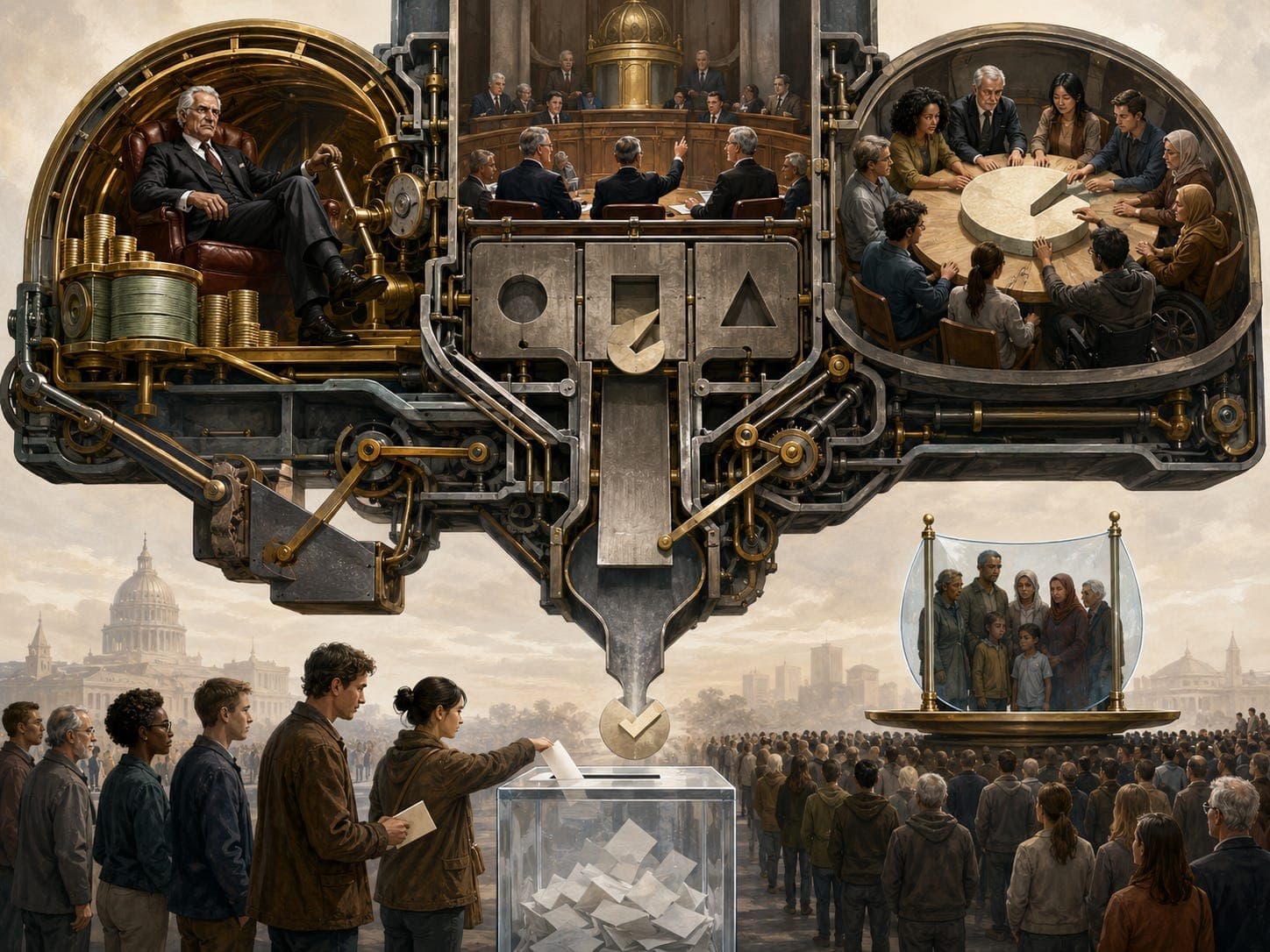
Picture a ballot paper in your hand. There is a question printed on it, and two boxes, yes and no. You can tick either one. What you cannot do is ask a different question. Someone else chose the question before the paper ever reached you. By the time it lands in your hand, the most important decision has already been made, and you had no part in it.
Walker Briefing is a reader-supported publication. To receive new posts and support my work, consider becoming a free or paid subscriber.
That is the thing worth talking about. Not how we vote. What we are allowed to vote on, and who decides that.
There is a whole family of ideas meant to fix this. They go by stiff names, the citizen-initiated referendum, the popular initiative, but the idea underneath all of them is simple. Let ordinary people put a question on the ballot themselves. Do not wait for politicians to decide the matter is fit to be asked. If enough citizens want a vote on something, they get one.
I will be honest with you. I like the sound of that. I have always believed decisions should sit as close as possible to the people they affect, and this is exactly the instinct those mechanisms are built to serve. But liking the sound of a thing is not the same as knowing what it does. So I went and looked at the places that already use it, to see what actually happens. Some of what I found I expected. Some of it I did not.
Start with the country that does it best. Switzerland has let its citizens propose changes to the constitution since 1891. Gather a hundred thousand signatures and your question goes to a national vote. Over more than a century, more than two hundred of these citizen proposals have gone to the people. Only about one in ten passed.
That low number is usually told as a happy story. Look how sensible the Swiss are, it goes; they could vote themselves anything and they don’t. But there is a quieter reason, and it has nothing to do with anyone being sensible. A Swiss proposal does not just need most of the country to agree. It needs most of the regions to agree as well. That second hurdle blocks a great deal on its own, no matter how the voters feel. So some of the restraint people admire is not the voters being wise. It is the machinery holding a brake. Hold on to that, because the pattern comes back.
I want to be fair to the Swiss machine, because it does real work. When citizens get a direct vote on government spending, spending tends to come down. And here is the subtle part. Even the proposals that lose often change things, because parliament, seeing a question coming, moves to head it off. The tool shapes the country even when it appears to fail. That matters, and I am not going to pretend it doesn’t.
Now the other end of the scale. In parts of the United States, California most of all, getting a question onto the ballot has become a business. Gathering the signatures takes money, and the money runs into the hundreds of millions, most of it corporate.
The easy conclusion writes itself. Money buys the ballot, the rich get what they want, and direct democracy is just power in a friendly mask. I believed something close to that before I looked properly. The best research says it is not that simple, and the correction is the whole point.
A researcher named Elisabeth Gerber went through the finances of more than a hundred and sixty of these campaigns. She found that big money is surprisingly bad at passing new laws the public dislikes. People vote those down however much is spent. Where money works, reliably, is the other way round. It is very good at blocking. It is very good at defending the way things already are.
Sit with that, because it is the heart of the matter. Money’s power here is lopsided. It is far better at stopping than at buying. One campaign in 2016 spent around a million dollars, collected two hundred and fifty thousand signatures, and still fell short of even getting on the ballot. The money bought the attempt. It did not buy the result.
So the real danger is not quite what it looks like. The danger is that this tool, sold as a way for ordinary people to change things, works best for the people who want to keep things exactly as they are.
There is a second danger, and it is a different animal. When a majority decides something directly, a majority can decide to take something away from a minority.
In 2009 the Swiss voted to ban the building of minarets. It passed, with most of the country and most of the regions in favour. The government had told people to reject it. They did it anyway, and the government was bound to carry it out. Human rights bodies condemned the result as discriminatory; that judgement is theirs, and I record it as theirs. The plain structural fact, which is mine to state, is that the machinery delivered something the country’s own elected institutions had refused, and it landed on a minority.
California did the same in sharper form. In 2008 a ballot measure changed the state constitution to ban same-sex marriage, by just over half the vote, taking away a right the courts had recognised only months earlier. It took years, and the courts, to undo it.
I have to be fair here too, or I am just picking the cases that suit me. The same Swiss machinery that banned minarets also voted to recognise same-sex partnerships, and later full marriage. The tool does not run in one direction, and that is exactly the point. A direct vote can hand a minority its rights and can tear them away, by the very same method, and nothing inside the machinery decides which.
Then there is the difference between two ways of asking a nation a hard question.
In 2016 Britain voted on leaving the European Union. Leave won, 52 to 48, near enough. There was no real process of working the matter through beforehand, and no plan for what leaving would actually mean. One question, one vote, a narrow result, and consequences that turned out to be permanent.
Ireland did something different with a question every bit as charged. Before the country voted on its abortion law, the question went first to ninety-nine ordinary citizens, chosen at random to look like the country, with a judge in the chair. They met across five weekends. They heard the law, the medicine, the ethics, the personal stories. Then they made a recommendation, parliament took it up, and the country voted. The change passed with two-thirds support.
I lean towards the Irish way, and because I lean that way I owe you a caution. The citizens’ panel landed on roughly the same answer the country later did. That looks like proof that the careful process produced a careful result. But it might only mean the country had already made up its mind, and the panel, being a fair sample of it, simply showed what was already there. The match is suggestive. It is not proof, and I will not dress it up as more than it is.
All of this is happening somewhere else. Australia has none of it. No state, and not the country as a whole, lets citizens put a question on the constitution. Only Parliament can. A change has to begin as a bill, pass both houses, and only then go to the people, on a question Parliament alone has written.
And that road is steep by design. Of forty-five changes put to Australians since Federation, eight have passed, and none since 1977. You need most of the country and most of the states both. So the question that bites in America, who can fund the signature drive to frame the ballot, does not even arise here. There is no signature drive. Parliament holds the pen.
The most recent test tells you about the weather, and the weather is all I will use it for. In 2023 Australians voted on a proposal to recognise an Aboriginal and Torres Strait Islander Voice, and it was defeated, with about sixty per cent voting no. The rights and wrongs of that proposal are not my subject, and I take no side on them here. What the result shows is simply how hard change is under this machinery, especially without the support of both major parties, which changes like it have always needed in order to pass.
So if the real problem is who controls the question, then the fix worth taking seriously is not a way to cast more votes. It is a way to decide what gets voted on.
The proposal runs like this. Do not let the question be written by whoever can fund a campaign. Hand it instead to a panel of citizens chosen by lot, who sit down and work it through properly and frame the question, before anything reaches a ballot. There is even an old word for two things yoked together to work as one unit: a syzygy. The panel frames. The people decide.
Ireland is that idea already working, not on paper but in the world. And here the earlier caution comes back, because it bears straight on the proposal. The Irish story shows that a citizens’ panel can produce a question the public will back. It does not, on its own, show that the working-through is what did it. I will say that plainly rather than glide past it, because gliding past it is exactly the temptation when the evidence flatters what you already hoped was true.
And notice what the fix does not touch. It answers who frames the question. It does nothing about the other danger, the majority that strips a right once the question has been put. Those are two separate problems, and they must not be folded into one. Solving the first leaves the second precisely where it was. Anything that handled both would need something more: a line drawn around certain rights, placing them beyond the reach of any vote, however fairly the question was framed. That line is missing here. I am naming it as missing, not pretending I have supplied it.
So where does this leave us. Not with a verdict, in the end, but with a clearer picture.
Direct democracy is neither the cure for captured power that its champions promise nor the mob rule its critics dread. It is a tool, and its worth depends almost entirely on things that sit upstream of the vote itself: on who gets to write the question, on what it costs to put one or to block it, and on whether anything at all stands between a bare majority and a minority’s rights. Build those upstream conditions well, as Ireland did with the question at least, and the tool can do real and creditable work. Leave them to look after themselves, and it serves most reliably the people who were already best placed to shape the question and to guard what suits them.
The instinct that started all this, that decisions should rest close to the people, is still a sound one. It is simply that a bare vote, on its own, turns out not to be enough to honour it.
One thread runs out of here and into what comes next. Twice in this story the thing that decided the outcome was not whether people voted. It was the level at which their votes were counted. Britain counted one nationwide total, and two of its nations were carried out of Europe against their own majorities. Australia counts states as well as people, exactly so that a bare national majority cannot override them. The same votes, counted at a different level, give a different result. That question, the question of scale, is where this goes next.
Walker Briefing is a reader-supported publication. To receive new posts and support my work, consider becoming a free or paid subscriber.

Written by
Hon Dr Brian Walker MLC
MB ChB · MRCGP · FRACGP · 45+ years as a GP
Brian Walker is a General Practitioner and Member for Western Australia in the WA Legislative Council. He is the Leader of the Legalise Cannabis Party WA and an advocate for evidence-based cannabis reform, healthcare improvement, and progressive policy in WA.
Share this article
Stay Updated
Get the latest news and parliamentary updates delivered to your inbox