Who Gets to Decide?
Direct Democracy as Structural Remedy The previous article in this series traced how votes become seats. The question there was the translation machinery: the architecture that converts marks on a ballot into the composition of a chamber, and the finding that the geometry of that conversion is a str
Brian Walker
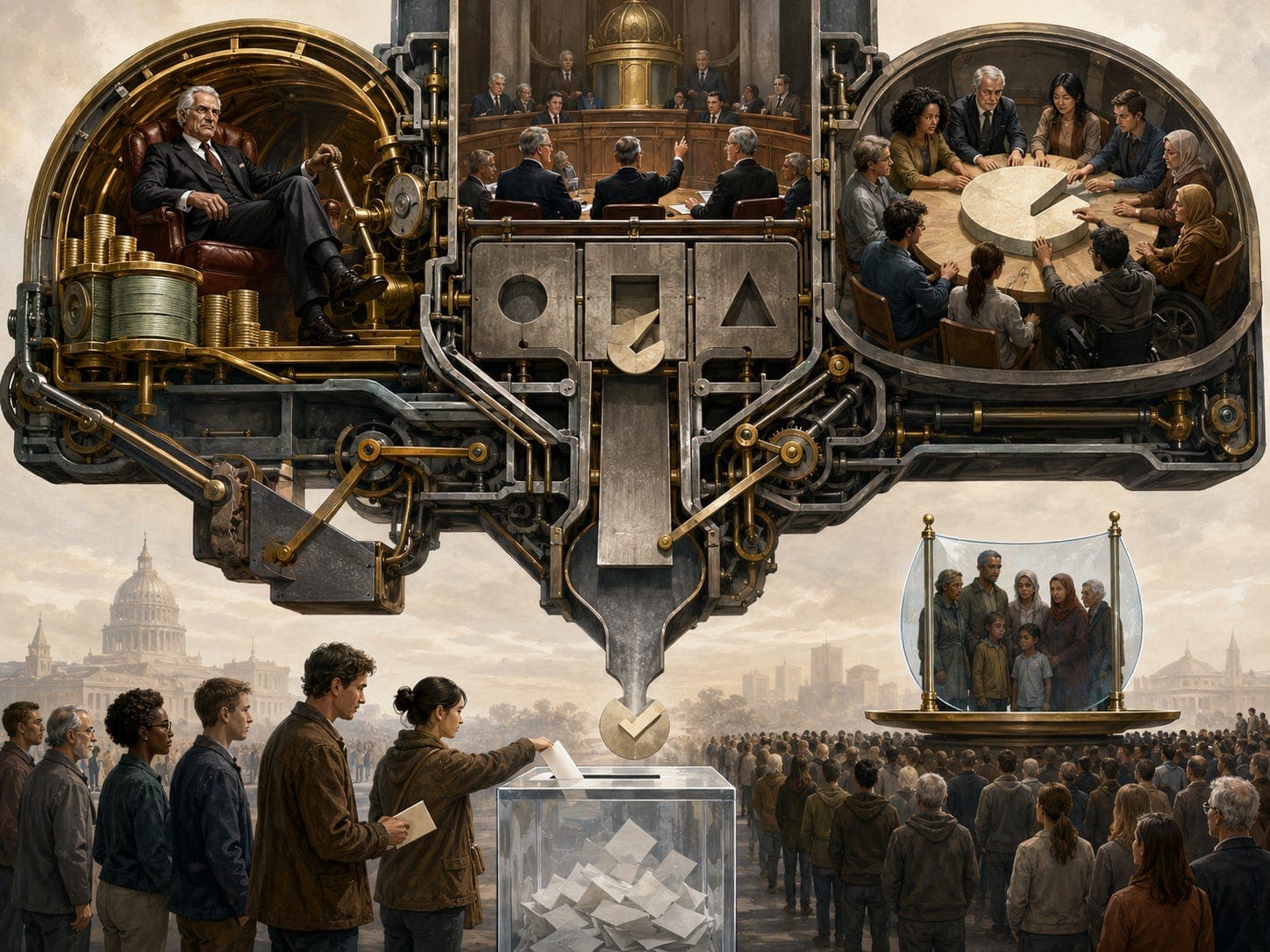
Direct Democracy as Structural Remedy
The previous article in this series traced how votes become seats. The question there was the translation machinery: the architecture that converts marks on a ballot into the composition of a chamber, and the finding that the geometry of that conversion is a structural variable in its own right, often doing the work we credit to the part of the system we happen to be watching. That whole inquiry, though, takes one thing for granted. It assumes the question is already on the ballot. Someone has already decided what the people will be permitted to vote on. Before the machinery that counts the answer comes the prior machinery that selects the question: who sets it, who is allowed to put it, and who is kept from putting it at all.
Direct democracy is the name for the family of mechanisms that promise to settle that prior question by handing it to citizens directly. The citizen-initiated referendum, the popular initiative, the binding plebiscite: each proposes that the people themselves should be able to place a question on the ballot and decide it, without waiting for a parliament to rule the matter fit to be asked. I come to this material with a sympathy I will not pretend away. The instinct that decisions should rest as close as possible to the people they bind is one I hold, and it is precisely the instinct this family of mechanisms is built to serve. But sympathy is not analysis. The mechanism has to be examined with the instrument this series applies to every proposed remedy: not whether it sounds democratic, but what it does, and for whom.
Walker Briefing is a reader-supported publication. To receive new posts and support my work, consider becoming a free or paid subscriber.
The case for direct democracy is strong, and it deserves to stand at full strength before it is tested. Its deepest argument is structural. Robert Michels gave the underlying problem its name more than a century ago in the iron law of oligarchy: the tendency of every representative organisation, however democratic in its origins, to drift toward control by a small group whose interests diverge from those of the people it was formed to represent. If that drift is a structural feature of representation rather than a failure of individual character, then no amount of replacing one set of representatives with another will cure it. What is needed is a channel that sits outside the representative system altogether, through which citizens can act when their representatives will not. Direct democracy is offered as exactly that channel. Macgregor, whose account of the democratic machinery this series engages and audits as a source, presents it in these terms: the structural interruption of elite capture rather than one more complaint about it.
The working example is Switzerland, and it is a serious one. The Swiss federal popular initiative has existed since 1891. It allows citizens to propose a constitutional amendment on collecting one hundred thousand valid signatures within eighteen months, after which the proposal goes to a national vote and must clear a double majority: a majority of voters across the country and a majority of the cantons. Of more than two hundred initiatives put to the federal vote across that history, roughly one in ten has been adopted, a low pass rate that the favourable reading takes as evidence the instrument has not produced the legislative free-for-all its critics predicted. Macgregor calls Switzerland the jewel in the democratic crown, and on its own terms the description is earned. The system is old, stable, and woven into the ordinary texture of Swiss civic life, its votes grouped on several Sundays a year, with official explanatory material posted to electors before each.
Two findings give the Swiss case analytical weight beyond its longevity. The first concerns spending. For the mandatory financial referendum, the mechanism by which certain budget decisions must be put to the electorate, the peer-reviewed evidence consistently associates the instrument with lower government spending: citizens handed a direct vote on the public purse have tended to restrain it. The second is subtler, and for the case in favour it is more interesting. A standing finding in the Swiss literature is the indirect effect. Initiatives that fail at the ballot frequently extract a parliamentary counter-proposal or shift the legislative agenda, so the instrument shapes policy well beyond the small fraction of initiatives that actually pass. The mechanism is not inert. It does real work even when it appears to lose. And the agenda argument is the heart of the matter. The claim direct democracy presses hardest is that representative bodies systematically exclude certain questions, that matters threatening the interests of the political class itself, or that no party finds it convenient to raise, simply never reach the floor. A parliament chooses what it will consider. A citizen initiative takes that choice away from the parliament. Whatever else proves true of the mechanism, this is its genuine structural promise.
The Swiss example, however, is not the only place the mechanism has run at scale, and the American record reads differently. In the initiative states of the United States, and California above all, the popular initiative has become a large and heavily funded industry. Qualifying a measure for the California ballot requires signatures equal to five per cent of the last gubernatorial vote for a statute and eight per cent for a constitutional amendment, and gathering them at that scale is no longer a volunteer enterprise. It is a paid, professionalised business, and the money involved runs to hundreds of millions of dollars per cycle, weighted heavily toward corporate spenders. The obvious conclusion to draw is that money buys outcomes, that the initiative has been captured by those who can pay for it, and that direct democracy in America is plutocracy in a populist costume. The obvious conclusion is too simple, and the best scholarship corrects it. Elisabeth Gerber’s study The Populist Paradox, built on the campaign finance records of well over a hundred and sixty direct-legislation campaigns across eight states, found that heavy spending does not reliably buy passage. Economic interest groups that spend large sums to pass a new law the public dislikes generally fail. Where money is reliably effective is on the other side of the ledger: in blocking initiatives and in defending the existing arrangement. Broad-based citizen coalitions, by contrast, are relatively better at passing new law than money is at stopping them.
The point is not that money does not matter. It is that money’s power in the initiative process is asymmetric. It is far more dependable as a veto than as a purchase. Gerber’s data come from an earlier and less lavishly funded era, and whether the asymmetry holds undiminished at today’s volumes is a fair question, but the shape of the finding has not been overturned, and the record carries an illustration of it. In 2016 a self-funded campaign committed around a million dollars to paid signature-gathering, collected some two hundred and fifty thousand signatures, and still fell roughly a hundred thousand short of qualifying for the ballot. Money bought the attempt. It did not buy the result. This is a more exact account of the danger than the capture story offers, and it points somewhere the capture story does not.
There is a second line in the record, and it cuts in a direction the money question does not. A direct mechanism lets a majority decide, and a majority can decide to take something from a minority. In November 2009 a Swiss federal popular initiative to ban the construction of minarets carried with 57.5 per cent of the vote and a majority in twenty-two of the twenty-six cantons. The federal government and the parliament had both opposed it and recommended its rejection. Under Swiss law the government was nonetheless bound to enact the amendment the voters had approved. The United Nations High Commissioner for Human Rights, Human Rights Watch, and the Council of Europe each condemned the result as discriminatory and as a breach of religious-freedom obligations. That characterisation is theirs, and I record it as theirs. The structural fact, which is mine to state, is that the mechanism produced an outcome the country’s own representative institutions had rejected, and produced it against a minority. California supplies the same pattern in sharper legal relief. In 2008 Proposition 8 amended the California constitution to ban same-sex marriage, passing with 52.24 per cent of the vote, and in doing so removed a right the California Supreme Court had recognised only months earlier. It was struck down in the federal courts in 2013 and formally repealed by a later ballot measure in 2024. For the years between, a bare majority had used the initiative to withdraw a right from a minority, and it took the courts to restore it.
These cases have to be set beside others, or they distort the picture as badly as the capture story does. The same Swiss instrument that produced the minaret ban also upheld same-sex partnership recognition by popular vote in 2005 and extended it to full marriage in 2021. The mechanism does not run in a single ideological direction. What the paired cases establish is narrower, and more useful, than either caricature: a direct majority vote can deliver a considered expansion of rights and can strip a right by the identical procedure, and nothing internal to the mechanism determines which.
The third line in the record concerns deliberation, and it turns on the difference between two ways of putting a charged question to a nation. In June 2016 the United Kingdom held a referendum on its membership of the European Union. The result was 51.9 per cent for leaving against 48.1 per cent for remaining, on a turnout of just over seventy-two per cent. The vote was legally advisory. It was held with no structured deliberative process before it and no specified plan for how a leave result would be implemented: a single question, one up-or-down vote, a narrow margin, and a consequence that proved binding in practice. Set against this is the Irish sequence, which put a comparably charged question through a different machine. Before Ireland voted on the Eighth Amendment, which governed the constitutional status of abortion, the question was handed first to a Citizens’ Assembly: ninety-nine citizens chosen at random to be broadly representative of the country, chaired by a Supreme Court judge, meeting across five weekends to hear legal, medical, ethical and personal evidence. The Assembly recommended repeal. The parliament was required to consider that recommendation, and in response set the referendum in motion. In May 2018 the amendment was repealed with 66.4 per cent of the vote, on a turnout near two-thirds. The Assembly’s own internal vote had closely tracked the eventual national result, roughly a year before the country went to the polls. That model had a predecessor in a slightly different form: the Convention on the Constitution, which sat from 2012 to 2014 and combined randomly selected citizens with serving parliamentarians, produced the recommendation that led to the 2015 marriage-equality referendum. The assembly that considered the Eighth Amendment was the purer version of it, citizens alone.
The contrast is the standing argument against the bare referendum: a single binding vote with no deliberative front-end produces a less considered decision than a process in which deliberation precedes and shapes the question. It is a serious argument, and the Irish case is its strongest evidence. It needs one caution. The argument is one I am inclined to favour, which is reason to state the caution rather than pass over it. The fact that the Assembly’s view matched the public result does not by itself prove that deliberation produced the alignment. It is equally consistent with the possibility that the country had already settled the question, and that the Assembly, being representative, reflected a settlement that existed before it sat. The correspondence is suggestive. It is not proof of cause, and I will not treat it as more than it is.
The Brexit vote carries a further feature that belongs to this analysis, distinct from the deliberation question. The 51.9 per cent was a single United Kingdom-wide majority. Beneath that aggregate the four nations of the union had voted differently. England and Wales returned majorities for leaving; Scotland and Northern Ireland returned majorities for remaining, Scotland by sixty-two per cent nationally and with a majority for remaining in every one of its thirty-two council areas. Both nations were withdrawn from the European Union on the strength of the UK-wide total, which England’s far larger electorate determined. There was no mechanism by which a contrary majority in a constituent nation could register as a veto, or as a threshold the result had to clear. Whether that arrangement was right or wrong turns on a question I am deliberately leaving open here, because it is the question the next article takes up: which unit counts as the relevant people, the nation or the union. The structural point is the only thing I draw from it now. The level at which the majority was measured decided the outcome, and a different choice of level would have produced a different outcome from the very same votes.
Lay the three lines of the record beside one another and a single variable comes into focus, the one this inquiry has been circling from the start. The Swiss indirect effect, the American asymmetry of money, the gulf between Brexit and Ireland: each points away from the bare mechanism and toward something upstream of it. The recurring variable the scholarship treats as decisive is not whether the people have a direct vote. It is who controls the question that reaches them, and who can mobilise the resources to put it there or to keep it off. The vote itself is the visible part. The architecture that determines what gets voted on, and what it costs to make that happen, is the system working beneath the surface. Even the low Swiss pass rate belongs here rather than where it is usually filed. The favourable reading credits it to citizen restraint, but a measure must carry both the national vote and a majority of cantons, and that double-majority bar is a structural brake that operates regardless of how cautious the electorate happens to be. Some of the restraint the instrument is praised for is the architecture, not the voters.
This is the same structural lesson the previous article reached by a different route, and the rhyme is worth naming, with one boundary I will hold to. There the finding was that the proportionality of an electoral result came from the districting, the drawing and sizing of electorates, while the preferential count most people imagine to be doing the work in fact did almost none of it. The mechanism everyone watched was not the mechanism that mattered. The structure of direct democracy rhymes with that, but the rhyme has a limit, and the limit cuts in both directions. In the electoral case the surface mechanism was close to inert. Here it is not. The Swiss evidence is clear that the direct instrument does real work, restraining spending where it governs the budget and shifting the agenda even when it loses, so the earlier finding cannot be carried across whole, and to say the mechanism does not matter would be to misread the record. The temptation that runs with my own sympathies points the other way, and it is the more dangerous of the two. The believer in direct democracy wants the bare vote to be the cure for capture. The evidence will not bear that weight. The mechanism does genuine work, but its value is conditional on the upstream architecture, not resident in the fact of its existence, and to credit the vote itself with more independent power than that is the believer’s characteristic mistake, and the one I am most concerned to avoid here.
If the determinative variable is who controls the question and who can fund or block it, then the Beneficiary Audit, the instrument this series turns on every remedy, returns an uncomfortable answer when it is turned on direct democracy itself. Run the mechanism through the asymmetry the record established and the beneficiary is not the abstract citizen in whose name the mechanism is justified. It is whoever frames the question, and whoever can pay to put one or to stop it. Because money blocks more reliably than it passes, the mechanism most dependably serves those defending an arrangement that already exists against those who would change it. This holds only as firmly as the asymmetry beneath it, and that asymmetry, established in an earlier and less heavily funded era, is shown but not proven to survive at present volumes; the conclusion is drawn at that strength and not beyond it. And because the question must be framed by someone, it most dependably serves whoever holds the framing power, which in an unstructured initiative system is whoever can fund the signature drive. The mechanism can also do something its advocates rarely advertise. It can manufacture durable structural lock-in. California’s Proposition 13, the 1978 initiative that capped property tax and imposed a two-thirds legislative supermajority for certain tax increases, has constrained that state’s fiscal policy for more than four decades. An instrument sold as the people restraining their government became a constraint that no ordinary legislative majority can lift. The mechanism that promises to break entrenchment proved equally able to set it in concrete.
There is a second way the beneficiary can be the wrong party, and it is distinct from the question of money and framing. It is the majoritarian harm already established in the record: the minaret ban, Proposition 8. There the problem is not that a funded interest captured the question. It is that the majority itself, deciding directly, removed a right from a minority that a deliberative or rights-constrained institution would have been likelier to protect. These are two different failure modes and they must not be folded into one. Capture concerns who controls the question before it is put. Majoritarian harm concerns what an unconstrained majority does once it is put. A design that solved the first would leave the second exactly where it found it.
All of this has been examined at one remove from Australia, in systems that already hold the mechanism. Australia does not. The structural fact that separates this country from every comparator in the record is that no Australian jurisdiction, state or federal, has ever adopted citizen-initiated-referendum legislation. Australians cannot place a question on a constitutional ballot. Only the federal Parliament can. A constitutional alteration must begin as a bill, pass both houses by an absolute majority, and only then go to the people, who vote on a question Parliament alone has framed. The record of that process is its own commentary: of forty-five proposals put since Federation, eight have carried, and none since 1977. The bar is deliberately high, requiring not only a national majority of voters but a majority of voters in at least four of the six states. This is the agenda-control variable at its most absolute. In the American case the question of who frames the ballot is a question of who can fund a signature drive. In Australia the question does not arise, because there is no signature drive to fund. The framing power over constitutional questions rests entirely with Parliament. Whatever the merits of that arrangement, it is the starting condition any serious proposal for Australian direct democracy would have to confront: not a mechanism to be reformed but a mechanism that does not exist, set inside a constitution built to make its own alteration difficult.
The most recent test of that machinery can be read as evidence about the environment, and it is only as evidence about the environment that I read it here. In October 2023 the proposed constitutional alteration to establish an Aboriginal and Torres Strait Islander Voice was put to the people and defeated, with just over sixty per cent voting No, on a turnout near ninety per cent. It failed the double majority comprehensively, securing a majority in no state, with the Australian Capital Territory the only jurisdiction to return a Yes majority. The merits of the Voice are not my subject, and I take no position on them in this analysis. What the result establishes is the steepness of the climb. A change put to the people under this machinery, and without the bipartisan support such changes have historically required to carry, met the fate the historical record would have predicted for it.
One feature of the Australian rule is worth holding up against the Brexit vote, because it shows the same structural variable from the opposite end. Brexit measured a single union-wide majority with no requirement that any constituent nation also consent, so that a contrary majority in Scotland and Northern Ireland could not register at all. The Australian double majority does the reverse. By requiring assent in a majority of states as well as nationally, it builds the consent of the constituent units into the threshold, so that a bare national majority cannot impose a constitutional change on the federation over the objection of the states. The same variable, the level at which the majority is measured, operates in Britain as an absence and in Australia as a protection. Which is the better design is not a question with a general answer, and it is the subject of the article that follows this one.
If the determinative variable is who frames the question, then the design response worth taking seriously is the one aimed precisely at that variable, and it is not a mechanism for casting more votes. It is a mechanism for deciding what is voted on. Macgregor proposes, in the part of his work dealing with the management of the referendum, that the questions put to a popular vote should be set and drafted not by whoever can fund a campaign but by a deliberative assembly of citizens chosen by lot. He calls the pairing a syzygy, pronounced SIZ-ih-jee. The word is Greek for two things yoked together into a single working unit, and the two things yoked here are a citizens’ assembly chosen by lot and the binding referendum to which it hands its question. The assembly deliberates and frames. The people decide. The purpose of the syzygy is to take the framing power away from money and give it to a representative sample of the public, deliberating under good conditions, before any question reaches a ballot at all.
The Irish sequence is this design working in the world rather than on paper. A randomly selected assembly deliberated, framed the question, and handed it to a national vote, and the considered judgement of the sample matched the country’s eventual decision. That is the strongest evidence available for the syzygy, and it is also where the caution stated earlier has to be repeated, because it bears directly on the proposal rather than at a distance from it. The Irish correspondence shows that a deliberative assembly can produce a question the public will endorse. It does not, on its own, show that the deliberation is what produced the endorsement. That evidentiary limit is one to state rather than pass quietly over. The syzygy answers the one variable this analysis has isolated, the framing of the question, and it answers it well. It does not touch the other failure mode, the majority that strips a minority right once the question is put. A design equal to both would have to carry something the syzygy does not, a constraint placing certain rights beyond the reach of any majority however well its question has been framed, and that constraint this analysis names as missing rather than supplies; it belongs to a later part of the inquiry, not to this one. Nor is it offered here as a general theory of deliberative democracy, which is a larger subject this series will reach in its own place. It is a response, anchored in the Irish experience and bounded to a single problem.
What the record will support, in the end, is a description rather than a verdict. Direct democracy is neither the cure for elite capture its strongest advocates present nor, the licence for mob rule its critics dread. It is a mechanism whose value depends almost entirely on conditions that sit upstream of the vote itself: on who is permitted to frame the question, on what it costs to put one or to block it, and on whether anything at all stands between a bare majority and a minority’s rights. Where those upstream conditions are well made, as the deliberative front-end in Ireland suggests the framing of the question at least can be, the mechanism is capable of real and creditable work. Where they are left to look after themselves, it most reliably serves those who were already positioned to shape the question and to defend the arrangements that suit them. The instinct that decision should rest close to the people remains a sound one. It is simply not, on this evidence, an instinct that the bare mechanism of a popular vote is by itself sufficient to honour.
One thread runs out of this analysis and into the next. Twice here the decisive factor was not whether the people voted but at what level their votes were counted: the single union-wide majority that carried Brexit over the contrary majorities of two of its nations, and the double majority that shields the Australian states against a bare national one. The level at which a majority is measured is a question of scale, and scale is a structural variable in its own right. It is the subject of the essay that follows.
Walker Briefing is a reader-supported publication. To receive new posts and support my work, consider becoming a free or paid subscriber.

Written by
Hon Dr Brian Walker MLC
MB ChB · MRCGP · FRACGP · 45+ years as a GP
Brian Walker is a General Practitioner and Member for Western Australia in the WA Legislative Council. He is the Leader of the Legalise Cannabis Party WA and an advocate for evidence-based cannabis reform, healthcare improvement, and progressive policy in WA.
Share this article
Stay Updated
Get the latest news and parliamentary updates delivered to your inbox