Who the System Punishes
Has your doctor ever cried beside you? Probably not, we are taught to keep our emotions aside from our professional behaviour when dealing with issues which could be life-threatening or challenging. We see these things pretty much every day, so it is no surprise that some become numb to the events,
Brian Walker
Has your doctor ever cried beside you? Probably not, we are taught to keep our emotions aside from our professional behaviour when dealing with issues which could be life-threatening or challenging. We see these things pretty much every day, so it is no surprise that some become numb to the events, others like myself can feel upset at a visceral level when we are prevented by <name your bureaucratic barrier> which prevents access to life-changing options. Think Centrelink, insurance companies, and government bureaucracies. Today I want you to look at an example of this and see if you can decipher a picture that merits attention.
Walker Briefing is a reader-supported publication. To receive new posts and support my work, consider becoming a free or paid subscriber.
Let me mention a situation I have often dealt with. Someone attends to see me as a last resort. They have a serious illness, let’s call it some form of cancer or autoimmune disease. Oncologists may have been involved with the GP, support nurses and allied health services. All right and proper, but the problem has not disappeared, hope is diminishing, and I am seen as someone who represents a second opinion. I see a younger person, often married with children at or near high school, currently in a job with a house to pay for, and so there is a lot to lose. What they tell me is that the previous approach did not work, the chemotherapy wrecked them, the radiation was damaging, the nerve pain was intolerable, and the thought of a colostomy or other serious procedure after surgical resection was just not acceptable. “Help me” they ask. My heart sinks a little when I suggest that the first thing to be done is reconnect with the specialists who have been avoided. Yes, let’s look at a script, often medical cannabis both for symptoms and also to manage anxiety, yes let’s look at the research you have brought that includes things that usually are refused by specialists, but may work.
But tell me, I ask, how may I help? And I listen. Insomnia? Anxiety? Pain? Fear of death? Don’t trust the system, so guide me? Often all they want is to try medical cannabis as a last resort, and as a prescriber of medical cannabis, will I prescribe? Maybe the workplace is intolerable, and something is needed to take the edge off, ease the pain, allow for a relaxed sleep, and for a while they can forget the dreams that bring them back to reality with sweat and a sudden fear. Or maybe just a bit of something to relax after a hard day.
It may take forty minutes to begin, but often what comes out, slowly and in no order, is a childhood with several kinds of abuse in it, an undiagnosed and untreated attention disorder, causing mood disorders such as anger, grief, and guilt. The resulting job failures resulted in reactive behaviour, and now the promise of childhood vanished in a predictable trajectory into misery. And now they are in front of me asking for help and a legal medication which is treated as illegal and expecting me to be the next in line to judge them. I don’t judge, I listen. Often a script for medical cannabis will emerge. It may not cure the cancer or the autoimmune disease, but it is a very useful support that may permit a resumption of more orthodox approaches.
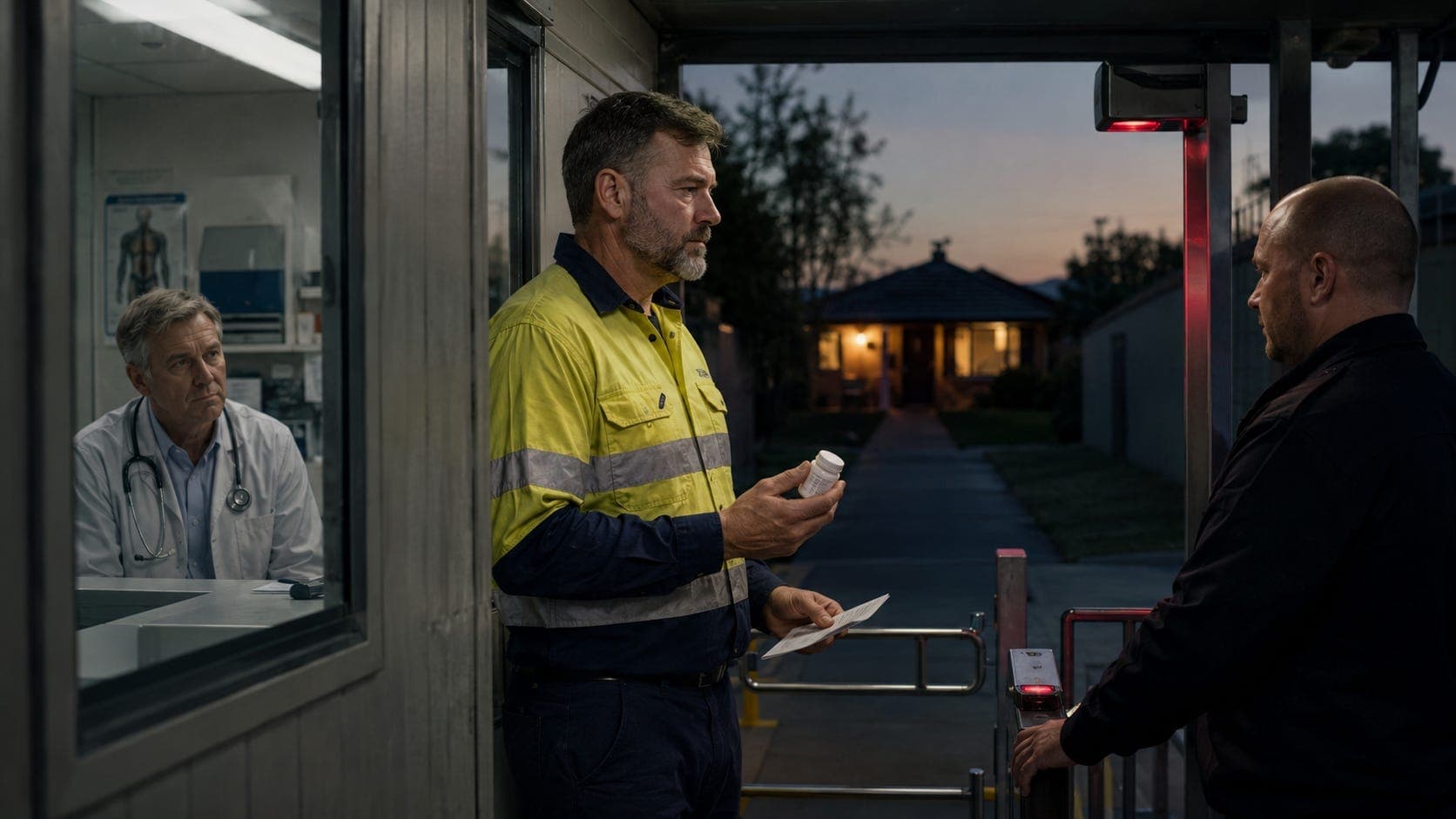
Unless, of course, you work for a living. HR demands a random drug test. A test for the presence of illicit drugs that may impair and cause risk at work. Let it be known that I absolutely agree that no one should work impaired especially where others can be injured, and I am most definitely of the view that no one should drive a vehicle when impaired. But on a worksite, if you have a prescription for an opiate, and test positive, you may go in, even if you have just finished a heroin binge at home. Benzodiazepines are fine with a prescription. Sedative drugs are fine with a prescription. Medical cannabis is banned even with a prescription. The patient who is managing the problem is stood down, may be declared an illicit drug user, may lose the job, and then lose the income, losing the ability to pay the mortgage, putting the family in stress, causing the relationship to break down, losing the family home, being accused by the spouse’s lawyer that you are a drug user, and have no rights to access your children. A psychiatric review is required, the psychiatrist demands you cease the medical cannabis and commences you on sedating drugs, leaving the thoroughly beaten patient more depressed than ever, labelled as unfit, and then an anti-psychotic drug is prescribed to assist with sleep, and now we have medicalised a patient into being described a failure.
And no-one tested for impairment. The tests used do not test for impairment, only presence.
I have heard this story so many times now. What is said is remarkably consistent. They knew the system was broken before I did. They watched workmates come on shift after a binge, test clean, and cause accidents, or have them. They watched colleagues on prescribed opioids and prescribed benzodiazepines wave a script at the tester and go to work, while their own script counted for nothing. In the face of company power the union was powerless and toothless. That refrain is repeated over and over by the employer, by the court, by the specialist, that they had failed. That they were drug users. That they were not fit to be a parent, or a spouse. Some of them stopped fighting because they could not see a way to win and sank. Some of them talked to me about ending it. In the year after a separation, close to one in three in this country reports thinking about suicide, against one in seven who has not separated. If any of this is your experience please call Lifeline on 13 11 14 and do it now.
Three years ago I chaired a parliamentary committee that looked at this. We recommended that the 2008 guidance be replaced and that medicinal cannabis “be treated in the same manner as other potentially impairing prescription drugs”. The government supported eleven of our sixteen recommendations, in full or in principle. It refused two. The one about driving it merely “noted”. On the workplace it did what we asked, on paper. In January 2025 WorkSafe replaced the 2008 guidance with a new sheet, and the sheet tells employers to treat a cannabis script the way they treat any other prescription that can impair. A sheet. It binds no-one, and no-one has to read it. On the roads it did less. Our recommendation to change the THC driving law was noted, and fifteen months later a working group was formed. The group’s report arrived on the due date in December 2025. The Minister for Health signed it and sent it to the Minister for Road Safety in February. It has been “under consideration” ever since, and when I ask in the House what day it landed, no-one will say. On the road, not a single word of the law has changed. In California, from the first of January 2024, an employer may not sack you, or refuse to hire you, on the strength of a test that finds “nonpsychoactive cannabis metabolites” in your urine. The legislature wrote its reason into the law: those leftovers “have no correlation to impairment on the job”. Employers there keep the right to a drug-free workplace and may test for impairment by any method that works. That principle is now law in the state of California, the biggest economy in that country. One large company, I told the Minister in August 2024, had already changed its practice in California to meet that law while holding to zero tolerance here in Western Australia. Same company. Same workers. Same urine. Different rules, depending on which side of the Pacific you pee.
In August 2024 I asked the Minister for Industrial Relations whether this State would give patients the same protection. Here is the answer, all of it: “Under Western Australia’s work health and safety legislation, a person conducting a business or undertaking is responsible for determining their drug and alcohol policy based on the specific hazards associated with their workplace.” I asked again in October. The same sentence came back, word for word. The company decides. The State has decided not to.
Is there any pattern you can see in this behaviour? Society and parliament agree that workplaces should be safe. A test for impairment does not test impairment, and high-functioning people are dismissed, lose everything, and the institutions are content. HR has done their job, the employer is covered by policies, and government has assessed the situation, and taken no action yet, sitting on its own working group’s report for nine months now. It could be worse. I am working on getting the government to act on the driving law its own committee told it to change three years ago, and its own working group has now told it how. The pattern is there, and the status quo has been successfully maintained, even if one person’s life has been destroyed.
Think about this for a moment. There is no current easy-to-use test for measurable impairment, so a proxy is used, even if the proxy fails to detect impairment. The government’s own committee told it three years ago that the test does not measure impairment, but the test used is cheap, and while the consequences for the individual are life-altering, the government is unaffected. The company kept its record. The court kept its order. The specialist kept certainty. The Minister kept the status quo. Who lost the house, the relationship, the children, future job prospects? Who was best served?
Now look a little larger. Is there a pattern to be seen? Rough sleeping in Western Australia doubled between the 2016 and 2021 censuses, from about a thousand people to more than two thousand three hundred; at the last census three in ten of everyone sleeping rough in Australia were here. There are more than twenty-three thousand applications on the social housing list, eight thousand of them priority. The modelling has said for a decade that it costs the State less to house these people than to leave them where they are; the one Australian trial that measured it found a real saving, smaller than the models promised, but real, and Perth’s own programme cut hospital emergency visits by nearly half among the people it housed. The department that does not build pays nothing for not building. The hospital pays. Our taxes pay.
Can you guess how much anger I feel at this situation? I am angry that real harm is being caused here, to minds and bodies and ultimately to our whole society. Harm is being caused by institutions, companies and governments both, and it looks to me like a simple lack of care for the ordinary people. I have been a doctor for a long time and know what it costs to spend forty minutes finding out what is true about a person. Medicare may not remunerate the doctor who does, but if the passion for wellness is there, then we do what must be done. Thousands of my colleagues do this every day.
Can we all agree that we need an honest instrument here? Can politicians agree that doing what is right, what serves the people we represent, what meets the proven facts, the science, the experience, is the prime duty for all who serve. Take the medical cannabis experience as an example of how what is right has been trampled underfoot, and a responsible government would not permit that. The analogy extends to managing homelessness, the education system, the justice system? That we serve the needs of our people by ensuring peace, safe relationships with our trading partners, creating a sovereign nation for a free people in a free country? Or am I calling for an unsustainable Utopia because we refuse to stand up for what is right?
Walker Briefing is a reader-supported publication. To receive new posts and support my work, consider becoming a free or paid subscriber.
Written by
Hon Dr Brian Walker MLC
MB ChB · MRCGP · FRACGP · 45+ years as a GP
Brian Walker is a General Practitioner and Member for Western Australia in the WA Legislative Council. He is the Leader of the Legalise Cannabis Party WA and an advocate for evidence-based cannabis reform, healthcare improvement, and progressive policy in WA.
Share this article
Stay Updated
Get the latest news and parliamentary updates delivered to your inbox