Why Democracy Is Failing
Where to Look In the middle of 2026 something happened in Australian politics that had never happened before. More people told the pollsters they would put One Nation first than would put either of the two big parties first. Not one stray poll. Several of them, run by different firms, all leaning th
Brian Walker
Where to Look
In the middle of 2026 something happened in Australian politics that had never happened before. More people told the pollsters they would put One Nation first than would put either of the two big parties first. Not one stray poll. Several of them, run by different firms, all leaning the same way. Somewhere between about 28 and 31 per cent, with one of them putting the party at 31, a record.
I need to be careful here straight away, because the number is easy to misread and the misreading does real work. Leading on first preferences is not the same as being on the verge of government. We count with preferences in this country, and once those are counted the same polls still put Labor in front. Anyone who tells you One Nation is about to win has the arithmetic wrong, and getting it wrong lets a protest vote be dressed up as a governing majority it is not. But the first-preference number is real, and it is new, and it is worth stopping on. For the first time, the party that more Australians named before any other was neither of the two that have run the place for a century.
So what is that vote. The pollsters who looked closely describe it plainly enough. It is strongest among people without a university degree, in the regions and the outer suburbs, and among older voters walking away from the Coalition. These are, in good part, the people outside the city, university-educated mainstream that both big parties have learned to talk to. And the people who study it read the movement not as love of a programme but as a withdrawal of faith from the parties that have held power.
Walker Briefing is a reader-supported publication. To receive new posts and support my work, consider becoming a free or paid subscriber.
This is not just our weather. It is part of a larger climate. The people who measure these things for a living, at a project called V-Dem based at the University of Gothenburg, reported that the world now holds more autocracies than democracies, ninety-one against eighty-eight, the first time that has been true in over twenty years. Their next report found it had got worse. The amount of democracy the average person on earth actually lives under has fallen back to where it was in 1978. Half a century of gains, they say, very nearly wiped out.
I want to be honest about what kind of claim that is. It comes from a dataset, not a pulpit. V-Dem works by asking thousands of specialists to score hundreds of measures, and it publishes how uncertain it is rather than hiding it. A determined critic can argue with any single call it makes, and the call to move the United States from a full liberal democracy down to a plainer electoral one is the most arguable of the lot. But the direction does not rest on this one instrument. Freedom House has now recorded twenty years in a row of decline in global freedom. The democracy index kept by the Economist Intelligence Unit tells a more mixed story: after eight years of falling it steadied in 2025, which the people who run it read not as a recovery but as a pause, with the United States still the glaring exception, still going down. The three do not agree on the slope of the last single year. They agree on the shape of the last twenty, and it is the shape that matters.
So why is it happening. Here I have to tell you the truth that most accounts skip, which is that the most serious people who study this do not agree with each other. An account that pretends they do should be distrusted on that ground alone. There are, roughly, four serious answers on the table, and I am going to give you all four, including the ones that cut against what I think, because a case that has to hide its rivals is not a case worth your trust.
The first is about money and work. The work that once held a town together got shipped offshore. Skills that used to mean a secure life stopped meaning it. A whole layer of people lost ground, and went looking for someone who promised to tear up the arrangement that left them behind.
The second is about culture, and it cuts against me, so I will put it plainly. Two researchers, Pippa Norris and Ronald Inglehart, argue that the country’s values shifted, over a long time and quite far, toward the open and the liberal, and that people who used to set the tone found themselves on the outside and pushed back. The inconvenient part, for someone like me who leans toward the money story, is that their work finds culture predicts the populist vote more strongly than the money measures do. I set that down without softening it.
The third is about leaders. Two analysts, Thomas Carothers and Brendan Hartnett, writing in 2024, argue that the fashionable story, that this is all driven by citizens democracy has failed, does not hold up well when you test it across many countries. The stronger driver, on their reading, is the ambition of leaders who set out to knock down the limits on their own power.
The fourth refuses to choose. Noam Gidron and Peter Hall argue that money and culture work on each other, and that the thing they make between them, a felt loss of standing, of status, is what actually moves the vote. Another scholar, Sheri Berman, looks at the whole argument and finds the pure money story mixed at best, giving real weight to the supply of populist leaders and to the way a country’s institutions handle grievance.
Four serious answers. They do not collapse into one. Whatever I tell you next has to be said in their company, not in their absence.
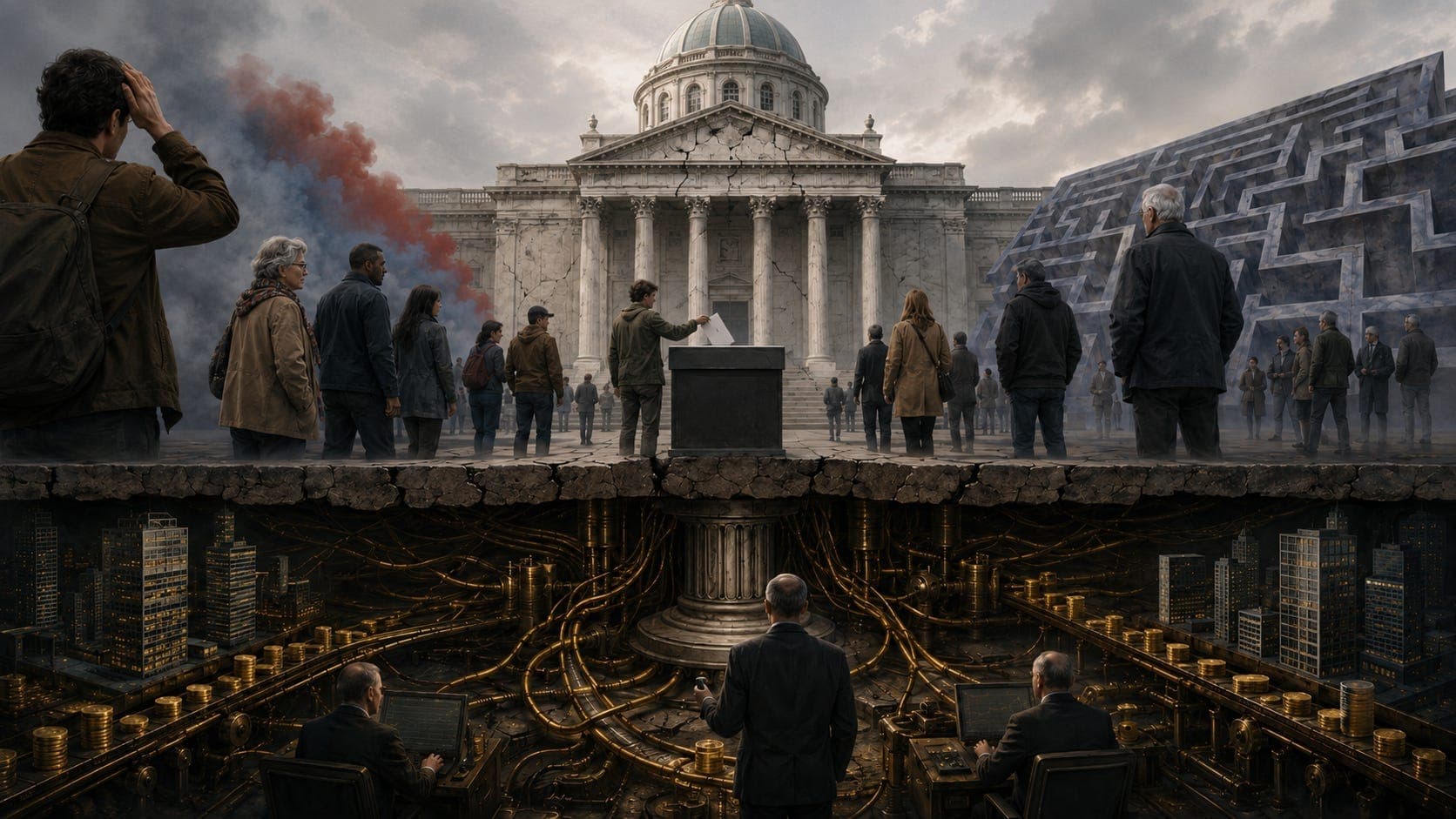
My own reading of the Australian case leans structural, and I hold it as a reading, argued among those four, not as a proven fact that has seen them off. The frame I find most useful is one set out by John Macgregor. He has a name for it. He calls it a Dyad: the point at which organised money and government have grown together so far that they work, in practice, as a single thing. On this view the daily contest of left against right is mostly surface. Underneath it sits a quiet agreement at the top, and the fight the public is handed is, in good part, a product of that arrangement rather than something the issues themselves require. The right is told the government is the problem. The left is told the corporations are. Each is kept busy with one half of the picture. The real gap, on this reading, is not between left and right at all. It is between an arrangement captured by concentrated wealth and the public that arrangement is meant to serve.
I called that the most explanatory reading, and having just put four rivals beside it I owe you what I mean by that. I do not mean it beats them. The culture account explains something real that the money story misses: the genuine unease a lot of people feel at how fast the social ground has moved, which does not reduce to their bank balance. The leaders account catches the part that personal ambition plays in tipping a weak system toward one-man rule. What the structural reading explains better than either, for us in particular, is the thing the other two mostly leave alone: the steady piling-up of wealth at the top, and the staying-power of a political fight that keeps the public arguing left against right, straight across the deeper line that actually divides them. It is the best account of that one pattern, the distribution and the division. It is not the whole truth, and a reading that claimed to be would fail the very test I am about to put it through.
Two things I have to be careful about. The argument is Macgregor’s, and I give it to you as something I have examined and come to support, not as my own invention. And this matters more: a diagnosis that swaps one false division for another has not cured the disease. It has only renamed it. If I told you the one real divide is the structure against the people, and nothing else, I would be doing in my own voice exactly what the divide-and-rule pattern does in its. Handing you a tidy enemy and inviting you to stop thinking. The honest version does not ask that. It stands next to the culture and the leaders accounts and claims only to be the better account of this one pattern.
There is one more bit of honesty I owe you, and it is the one most writers leave out. The question I would put to any story, who gains if you come to believe it, I have to put to my own. If you accept that the heart of the problem is a captured arrangement, you are some way toward accepting that the repair lies in equipping ordinary people, and trusting them, to act for themselves. That is a politics I hold. I would rather you knew it than found it out later. Saying it is not a confession that the reading is wrong. It is the price of asking you to trust it.
So let me put down what the evidence actually carries, and not a gram more, because the urge to make numbers say more than they do is exactly the slip that hands a critic his opening.
Start with the distribution, which has moved steadily one way. In 2022 and 2023, by the measure used in a study run by ACOSS and the University of New South Wales, about one in seven people in Australia were living below the poverty line. Roughly 3.7 million people. Among children, closer to one in six. That was up from about one in eight only two years before. Over a similar stretch, the average wealth of the richest tenth of households grew by 84 per cent, while the bottom sixty per cent grew at a little over half that rate. Close to half of all the growth in household wealth since 2003 went to the top tenth alone. And households run by someone under thirty-five now hold about five per cent of the nation’s wealth.
Those figures are solid, and I will let them carry only what they prove. The recent rise in poverty was not, on the evidence, wages being squeezed. Between 2021 and 2023 the lowest-paid tenth actually saw their wages grow faster than the highest-paid did. The study puts the rise down to two things instead: the emergency income supports that had briefly lifted people over the line during the pandemic being taken away again, and a steep climb in rents. That is a narrower claim than the sweeping one, and it is the one the numbers will bear. As the scholar Zehra Arat puts the mechanism, it is not inequality in the abstract that eats away at a democracy’s legitimacy so much as the wearing-down of the things that meet people’s basic needs. A structural reading does not need the wage story to be true. It needs only what is in front of us. An arrangement under which wealth gathers reliably at the top while poverty deepens at the bottom, and under which the recent worsening traces back to choices about welfare and housing, not to any law of nature.
Now put the protest vote back against that background. When a large and rising share of citizens place their mark with a party of protest, the most economical reading is not that they have grown foolish, or been duped. It is that a system has stopped showing them, in terms they can feel in their own lives, that it works for them. Compulsory voting matters here. In this country, disaffection does not show up as an empty chair. It shows up as a mark on a ballot, and the mark has to land somewhere. The disaffection is real, and it is rational. The fault it records sits in the arrangement that produced it, not in the people recording it.
And yet that same disaffection is constantly handed an explanation of itself that points away from the arrangement and toward something far easier to see. In the 2025 federal campaign one of the loudest answers on sale was that the cause of the country’s housing pressure, its strained hospitals and schools, its crowded roads, was immigration. The most heavily funded version of that message did not come from One Nation, which is a separate thing and should not be confused with it. It came from the Trumpet of Patriots, the party funded and chaired by the mining billionaire Clive Palmer. Its campaign material named immigration as the cause of the strain and promised to cut it by eighty per cent. Palmer has said the campaign cost him about sixty million dollars, among the heaviest advertising spends of any party that year.
Let me claim no more than the public record carries. I am not in a position to say what anyone believed, and I do not need to be. Two matters of record are enough. The first is that the campaign returned almost nothing. The Trumpet of Patriots won no seats and a little under two per cent of the House vote. The most expensively advertised version of the immigration explanation persuaded very nearly no one. Whatever standing the idea has in this country, it was not bought, and the money plainly did not manufacture belief. The second is a matter of proportion. Immigration does add to the pressure on housing. The economists who study housing count rapid population growth, of which migration is one part, among the genuine strains on supply. But it is one factor among several, and a secondary one, and it sits well down the list of what voters themselves say worries them most, behind the cost of living and the price of housing itself. To take a real but partial and secondary cause and advertise it, at that price, as the cause is not to explain the country’s troubles. It is to point a person’s entirely justified frustration at a target far larger in the telling than it is in fact.
It is worth being exact about what kind of misdirection this is. The evidence does not support a story of stoked racial hatred, and I am not going to pretend it does. Support for a diverse society stays high in Australia. The most careful survey work, by the Scanlon Foundation, ties rising worry about immigration numbers to housing and the cost of living, not to any turning against migrants as people. What the record shows is a structural complaint relocated, expensively and over and over, onto a visible and convenient group, out of all proportion both to immigration’s real part in the problem and to anything the spending bought at the ballot box. Concentrated wealth buying a populist misdirection. A plutocracy in a populist costume. The citizen who finds the message convincing has not been made a fool of. He has been handed a map on which one minor road is drawn as the only road, by people with the means to print and distribute millions of copies of it, and a distorted map handed to an intelligent traveller will still send him the wrong way.
There is one explanation left, and it is the one most flattering to our habits. It says the trouble lies in the people we elect, and the cure is to elect better ones. It is the most natural thing in the world to believe, and it is a symptom mistaken for the disease. Macgregor puts the underlying point with unusual clarity. A plutocracy, he writes, will form even when the wealthy mean well, so long as there are no people’s institutions to prevent it. The force of that is that it lifts the whole question out of the realm of character. A machine that rewards the service of concentrated money will, over time, select the people willing to provide it and wear down the people who are not, and it will do so whatever sort of people they happen to be. Replace the faces and leave the machine in place, and you have not found a remedy. You have found the activity that stands in for one. What the remedy might be I am leaving, on purpose, for another day. The only point here is that it will not be found by hunting for better people.
Stand back from the three explanations that crowd the public square, and a pattern shows itself. We are told the problem is immigration, or bad leaders, or a public that has lost its judgement. Each of them, once you pick it up, leaves the underlying arrangement exactly where it was. Blame the migrant, and the distribution of wealth and power does not move an inch. Blame the politician, and we busy ourselves changing the names on the doors while the structure behind them stands untouched. Blame the voter, and we arrive by the shortest road of all at the oldest and most convenient conclusion there is. That ordinary people cannot be trusted to run their own affairs, and had better leave it to their betters.
I know a diagnosis is not a neutral act, and I have shown you my hand. I have told you which reading I find most explanatory, and I have told you plainly what I stand to gain if you accept it. So let me put the weight somewhere it does not depend on my preferences at all. The striking thing about those three comforting explanations is not that any one of them is simply false. It is what they have in common. Every one of them, whatever the person offering it intends, draws your eye away from the same thing. The arrangement itself. The way wealth and policy have grown together, and the distribution that arrangement produces. Set my reading aside entirely, and you still have to account for that. That the three most comfortable explanations on offer all happen to spare the same arrangement any scrutiny. It does not tell us what to do. It tells us where to look. And it raises a question it does not yet answer, the one the next chapter takes up. Not whether the people can be trusted to put this right. But what a people would need to be equipped with, in order to do so.
Walker Briefing is a reader-supported publication. To receive new posts and support my work, consider becoming a free or paid subscriber.

Written by
Hon Dr Brian Walker MLC
MB ChB · MRCGP · FRACGP · 45+ years as a GP
Brian Walker is a General Practitioner and Member for Western Australia in the WA Legislative Council. He is the Leader of the Legalise Cannabis Party WA and an advocate for evidence-based cannabis reform, healthcare improvement, and progressive policy in WA.
Share this article
Stay Updated
Get the latest news and parliamentary updates delivered to your inbox